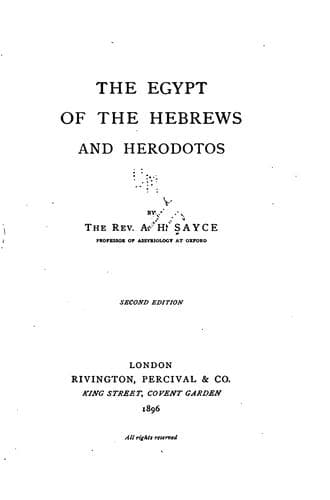
The Egypt of the Hebrews and HerodotosSayce, A. H. (Archibald Henry)
History
The Egypt of the Hebrews and Herodotos
Sayce, A. H. (Archibald Henry)
Egypt -- History, Ancient
Was “the war of the Lord” in Suphah waged against the Pharaoh of Egypt?
Chronology is in favour of it, and if the enemies of the Israelites were
not the Egyptian army, it is hard to say who else they could have been. We
know from the Pentateuch that they were not the people of Edom; “meddle
not with them,” the Israelites were enjoined; the children of Esau were
their “brethren,” and God had “given Mount Seir unto Esau for a
possession.”
But whether or not Ramses III. and the tribes of Israel ever came into
actual conflict, it must have been during his reign that the first
Israelitish conquests in Canaan were made. The settlement of the twelve
tribes in Palestine was coeval with the final decay of the Egyptian
monarchy.
CHAPTER IV. THE AGE OF THE ISRAELITISH MONARCHIES.
Ramses III. was the last of the great Pharaohs in whose veins ran native
Egyptian blood. His successors all bore the same name as himself, but they
possessed neither his energy nor his power to rule. He had saved Egypt
from further attack from without, and it was well he had done so, for the
feeble monarchs of the twentieth dynasty would have been unable to resist
the foe. They ceased even to build or to erect the monuments which
testified to the prosperity of the country and the progress of its art.
The high-priests of Amon gradually usurped their authority, and a time
came at length when the last of the Ramses fled into exile in Ethiopia,
and a new dynasty governed in his stead. But the rule of the new monarchs
was hardly acknowledged beyond the Delta; Thebes was practically
independent under its priest-kings, and though they acknowledged the
authority of the Tanite Pharaohs in name, they acted, in real fact, as if
they were independent sovereigns. One of them, Ra-men-kheper, built
fortresses not only at Gebelên in the south, but also at El-Hîbeh in the
north, and thus blocked the river against the subjects of the Tanite
princes, as well as against invaders from the south. At times, indeed, the
Tanite Pharaohs of the twenty-first dynasty exercised an actual
sovereignty over Upper Egypt, and Smendes, the first of them, quarried
stone at Dababîyeh, opposite Gebelên, with which to repair the canal of
Luxor; but, as a general rule, so far as the south was concerned, they
were Pharaohs only in name. The rival dynasty of Theban high-priests was
at once more powerful and more king-like. They it was who, in some moment
of danger, concealed the mummies of the great monarchs of the eighteenth
and nineteenth dynasties in the pit at Dêr el-Bahâri, and whose own
mummies were entombed by the side of those of a Thothmes and a Ramses.
Public-domain text, read in full here on John Shaqi.
Reviews
Reviews
No reviews yet
Be the first to share your thoughts on this work.
Elsewhere in the archive
Join the Discussion
Join the discussion
Sign in to leave a comment or review.
Sign InorCreate an account