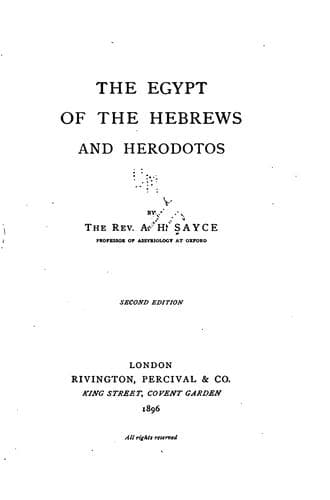
The Egypt of the Hebrews and HerodotosSayce, A. H. (Archibald Henry)
History
The Egypt of the Hebrews and Herodotos
Sayce, A. H. (Archibald Henry)
Egypt -- History, Ancient
The Egyptian wife of Solomon was the daughter of one of the last Pharaohs
of the twenty-first dynasty. She brought with her as a dowry the
Canaanitish city of Gezer. Gezer had been one of the leading cities of
Palestine in the days of the Tel el-Amarna correspondence, and through all
the years of Israelitish conquest it had remained in Canaanitish hands. It
was a Pharaoh of Tanis, and not an Israelite, into whose possession it was
destined finally to fall.
The waning power of Solomon in Israel coincided with the waning power of
the twenty-first dynasty. Long before the death of the Hebrew monarch, a
new dynasty was reigning over Egypt. Shishak, its founder, was of Libyan
origin. His immediate forefathers had commanded the Libyan mercenaries in
the service of the Pharaoh, and inscriptions lately discovered in the
Oasis of El-Khargeh write the name Shashaka. The Egyptians slightly
changed its pronunciation and made it Shashanq, but in the Old Testament
the true form is preserved.
Shishak brought new vigour into the decaying monarchy of the Nile. The
priest-kings of Thebes went down before him, along with the effete
Pharaohs of Tanis. It may be that Solomon attempted to assist his
father-in-law; if he did so, the only result was to bring trouble upon
himself. His rebel subject Jeroboam fled to Egypt, and found shelter and
protection in Shishak’s court.
Shishak must have looked on with satisfaction while the neighbouring
empire of Israel fell to pieces, until eventually the central power itself
was shattered in twain. The rebel he had so carefully nurtured at his own
court was the instrument which relieved him of all further fear of danger
on the side of Asia. So far from being a menace to Egypt, Jerusalem now
lay at the mercy of the Egyptian armies, and in the fifth year of
Rehoboam, Shishak led his forces against it. The strong walls Solomon had
built were of no avail; its temple and palace were plundered, and the
golden shields in its armoury were carried away. A record of the campaign
was engraved by the conqueror on the southern wall of the temple of Amon
at Karnak. There we read how he had overthrown the Amu or Asiatics, and
the Fenkhu or people of Palestine, and underneath are the cartouches, each
with the head of a captive above it, which contain the names of the
conquered places. At the outset come the names of towns in the northern
kingdom of Israel. But, as Professor Maspero remarks, this does not prove
that they were actually among the conquests of Shishak. If Jeroboam had
begged his aid against Judah, and thereby acknowledged himself the vassal
of the Pharaoh, it would have been a sufficient pretext for inserting the
names of his cities among the subject states of Egypt. But it may be that
the campaign was directed quite as much against Israel as against Judah,
and that Judah suffered most, simply because it had to bear the brunt of
the attack.
Public-domain text, read in full here on John Shaqi.
Reviews
Reviews
No reviews yet
Be the first to share your thoughts on this work.
Elsewhere in the archive
Join the Discussion
Join the discussion
Sign in to leave a comment or review.
Sign InorCreate an account