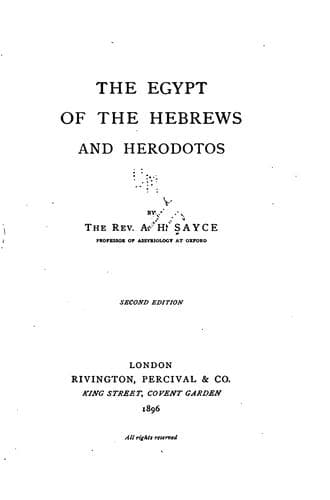
The Egypt of the Hebrews and HerodotosSayce, A. H. (Archibald Henry)
History
The Egypt of the Hebrews and Herodotos
Sayce, A. H. (Archibald Henry)
Egypt -- History, Ancient
In any case, the list of vanquished towns begins first with Gaza, the
possession of which was necessary before the Egyptian army could force its
way into Palestine; then come Rabbith of Issachar, Taanach, near Megiddo,
Hapharaim and Beth-Horon, while Mahanaim, on the eastern side of the
Jordan, is also included among them. But after this the list deals
exclusively with the towns and villages of Judah, and of the Bedouin
tribes in the desert to the south of it. Thus we have Ajalon and Makkedah,
Socho and Keilah, Migdol and Beth-anoth. Then we read the names of Azem
and Arad, farther to the south, as well as of the Hagaraim or “Enclosures”
of Arad, and Rabbith ’Aradai, “Arad the capital.” Next to Arad comes the
name of Yurahma, the Jerahme-el of the Old Testament, the brother of Caleb
the Kenizzite (1 Chron. ii. 42) whose land was ravaged by David (1 Sam.
xxx. 29). But the larger portion of the list is made up of the names of
small villages and even Bedouin encampments, or of such general terms as
Hagra, “enclosure,” Negebu, “the south,” ’Emeq, “the valley,” Shebbaleth,
“a torrent,” Abilim, “fields,” Ganat, “garden,” Haideba, “a quarry,” and
the Egyptian Shodinau, “canals.”(8) Among them we look in vain even for
names like those of Gezer and Beer-sheba. Jerusalem, too, is conspicuous
by its absence, unless we agree with Professor Maspero in seeing it in the
last name of the list (No. 133), of which only the first syllable is
preserved. Were it not for the record in the First Book of Kings, we
should never have known that the campaign of Shishak had inflicted such
signal injury on the kingdom of Judah.
Champollion, indeed, the first discoverer of the list and of its
importance, believed that he had found in it the name of the Jewish
capital. The twenty-ninth cartouche reads Yaud-hamelek, which he explained
as signifying “the kingdom of Judah,” while Rosellini made it “the king of
Judah.” But both interpretations are impossible. _Melek_, it is true,
means “king” in Hebrew, but “king of Judah” would have to be
_melek-Yaudah_; “kingdom of Judah,” _malkûth-Yaudah_. In the Semitic
languages the genitive must follow the noun that governs it.
Public-domain text, read in full here on John Shaqi.
Reviews
Reviews
No reviews yet
Be the first to share your thoughts on this work.
Elsewhere in the archive
Join the Discussion
Join the discussion
Sign in to leave a comment or review.
Sign InorCreate an account