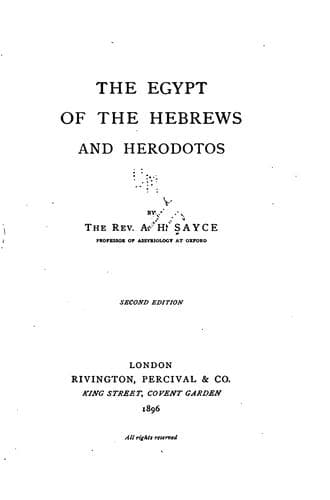
The Egypt of the Hebrews and HerodotosSayce, A. H. (Archibald Henry)
History
The Egypt of the Hebrews and Herodotos
Sayce, A. H. (Archibald Henry)
Egypt -- History, Ancient
Judah had profited by the revolution which had been so disastrous to the
monarchy of the Nile. The overthrow of the Babylonian empire and the rise
of Cyrus had brought deliverance from exile and the restoration of the
temple and its services. In the Jewish colony at Jerusalem, Cyrus and his
successors had, as it were, a bridle upon Egypt; gratitude to their
deliverer and freedom to enjoy the theocracy which had taken the place of
the Davidic monarchy made the Jewish people an outpost and garrison upon
whose loyalty the Persian king could rely.
The yoke of the Zoroastrian Darius and his descendants pressed heavily, on
the other hand, upon the priests and people of Egypt. Time after time they
attempted to revolt. Their first rebellion, under Khabbash, saved Greece
from the legions of Darius and postponed the day of Persian invasion to a
time when the incapable Xerxes sat upon the throne of his energetic
father. A second time they rose in insurrection in the reign of Artaxerxes
I., the successor of Xerxes. But under Artaxerxes II. came a more
formidable outbreak, which ended in the recovery of Egyptian independence
and the establishment of the last three dynasties of native kings.
For sixty-five years (from B.C. 414 to 349) Egypt preserved its
independence. More than once the Persians sought to recover it, but they
were foiled by the Spartan allies of the Pharaoh or by the good fortune of
the Egyptians. But civil feuds and cowardice sapped the strength of the
Egyptian resistance. Greek mercenaries and sailors now fought in the ranks
of the Persians as well as in those of the Egyptians, and the result of
the struggle between Persia and Egypt was in great measure dependent on
the amount of pay the two sides could afford to give them. The army was
insubordinate, and between the Greek and Egyptian soldiers there was
jealousy and feud. Nektanebo II. (B.C. 367-49), the last of the Pharaohs,
had dethroned his own father, and though he had once driven the Persian
king Artaxerxes Ochus back from the coasts of Egypt, he failed to do so a
second time. The Greeks were left to defend themselves as best they could
at Pelusium, while Nektanebo retired to Memphis with 60,000 worthless
native troops. From thence he fled to Ethiopia with his treasures, leaving
his country in the hands of the Persian. Ochus wreaked his vengeance on
the Egyptian priests, destroying the temples, demanding a heavy ransom for
the sacred records he had robbed, setting up an ass—a symbol in Egyptian
eyes of all that was evil and unclean—as the patron-god of the conquered
land, and slaying the sacred bull Apis in sacrifice to the new divinity.
The murder of Ochus by his Egyptian eunuch Bagoas was the penalty he paid
for these outrages on the national faith.
Public-domain text, read in full here on John Shaqi.
Reviews
Reviews
No reviews yet
Be the first to share your thoughts on this work.
Elsewhere in the archive
Join the Discussion
Join the discussion
Sign in to leave a comment or review.
Sign InorCreate an account