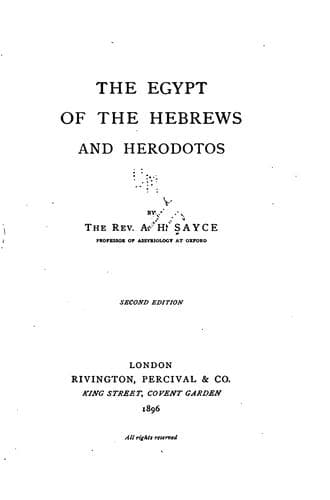
The Egypt of the Hebrews and HerodotosSayce, A. H. (Archibald Henry)
History
The Egypt of the Hebrews and Herodotos
Sayce, A. H. (Archibald Henry)
Egypt -- History, Ancient
The translation of the Hebrew Scriptures into Greek about the same period
is a yet more striking illustration of the same fact. The name of
“Septuagint,” which the translation still retains, perpetuates the legend,
derived from the false Aristæas, of its having been made all at one time
by seventy (or seventy-two) translators. But internal evidence shows that
such could not have been the case. The various books of the Canon were
translated at different times, and the translators exhibit very different
degrees of ability and acquaintance with the Hebrew language. The
Pentateuch was the first to be rendered into Greek; the other books
followed afterwards, and it would appear that the Book of Ecclesiastes
never found a place in the translation at all. The Greek translation of
the book which is now found in the Septuagint was probably made by Aquila.
It was under Ptolemy II., who justified his title of Philadelphus, or
“Brother-loving,” by the murder of his two brothers, that the work of
translation was begun. Ptolemy Sôtêr, his father, had resigned his crown
two years before his death, and the event proved that his confidence in
his son’s filial piety was not misplaced. The coronation of Philadelphus
at Alexandria was celebrated with one of the most gorgeous pageants the
world has ever seen, the details of which are preserved by Athenæus. Under
the new king the internal development of the monarchy went on apace. The
canal was opened which connected the Nile with the Red Sea, and at its
outlet near Suez a town was built called Arsinoê, after the king’s sister.
The ports of Berenikê and Philotera (now Qoseir) were constructed and
fortified on the coast of the Red Sea, and roads made to them from Koptos
and Syênê on the Nile. In this way the ivory and gems of the Sudân could
be brought to Egypt without passing through the hostile territories of the
Ethiopians in Upper Nubia. In the eastern desert itself the mines of
emerald and gold were worked until the royal revenue was increased to more
than three millions sterling a year.
Public-domain text, read in full here on John Shaqi.
Reviews
Reviews
No reviews yet
Be the first to share your thoughts on this work.
Elsewhere in the archive
Join the Discussion
Join the discussion
Sign in to leave a comment or review.
Sign InorCreate an account