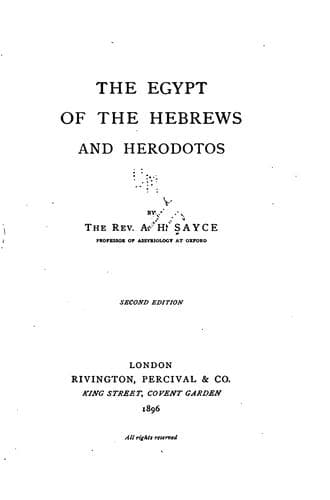
The Egypt of the Hebrews and HerodotosSayce, A. H. (Archibald Henry)
History
The Egypt of the Hebrews and Herodotos
Sayce, A. H. (Archibald Henry)
Egypt -- History, Ancient
Cleopatra was murdered by her younger and favourite son, and Lathyrus
succeeded after all in obtaining the throne of Egypt, which he ascended
under the title of Sôtêr II. (B.C. 87). His short reign of six years was
signalised by the destruction of Thebes. Upper Egypt was still in a state
of effervescing discontent, and the crimes of the last reign caused it to
break into open rebellion. The government was weak and wicked; the Greeks
had lost their vigour and power to rule, and their armies were now mere
bodies of unruly mercenaries. But the Thebans were not wealthy or strong
enough to withstand Alexandria when helped by the resources of the
Mediterranean. The revolt was at last suppressed, Thebes taken by storm,
and its temples, which had been used as fortresses, battered and
destroyed. The population was put to the sword or carried into slavery,
and the capital of the conquering Pharaohs of the past ceased to exist.
Its place was taken by a few squalid villages which clustered round the
ruins of its ancient shrines. Karnak and Luxor, Medinêt Habu and Qurnah,
were all that remained of the former city. Under the earlier Ptolemies it
had been known as Diospolis, “the city of Zeus” Amon, the metropolis of
Upper Egypt; from this time forward, in the receipts of the tax-gatherers,
it is nothing more than a collection of “villages.” Its priests were
scattered, its ruined temples left to decay. What the Assyrian had failed
to destroy and the Persian had spared was overthrown by a Ptolemy who
called himself a king of Egypt.
After the death of Lathyrus the internal decay of the monarchy went on
rapidly. A prey to civil war and usurpation, it was allowed to exist a
little longer by the contemptuous forbearance of the Romans, who waited to
put an end to it until they had drained it of its treasures. The kingdom
of the Asmonæans at Jerusalem also had tottered to its fall. Family
murders and civil feuds had become almost as common among them as among
the Ptolemies, and as in Egypt, so too in Palestine, Rome was called in to
mediate between the rival claimants for the crown. In B.C. 63 Jerusalem
was captured by Pompey after a three months’ siege, its defenders
massacred, its fortifications destroyed, and its royal house abolished.
The Roman victor entered the Holy of Holies, and Palestine was annexed to
the Roman empire.
Among the remnant which still retained the faith of their forefathers the
Roman conquest and the profanation of the temple gave new strength to the
conviction that the Messiah and saviour of Israel must surely soon appear.
The conviction finds expression in the so-called Psalms of Solomon, of
which only a Greek copy survives. The high hopes raised by the successes
of the Maccabean family were dashed for ever, and the temporal power of
Judah had vanished away. Henceforth it existed as a nation only on
sufferance.
Public-domain text, read in full here on John Shaqi.
Reviews
Reviews
No reviews yet
Be the first to share your thoughts on this work.
Elsewhere in the archive
Join the Discussion
Join the discussion
Sign in to leave a comment or review.
Sign InorCreate an account