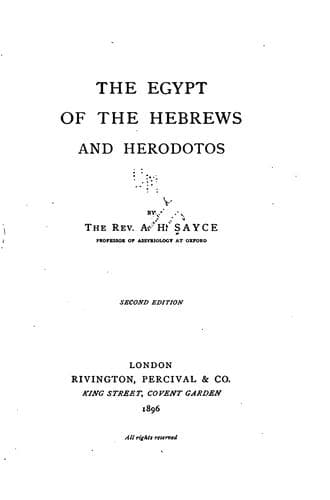
The Egypt of the Hebrews and HerodotosSayce, A. H. (Archibald Henry)
History
The Egypt of the Hebrews and Herodotos
Sayce, A. H. (Archibald Henry)
Egypt -- History, Ancient
For more than half a century Egypt had been closed to Greek curiosity.
There had been an earlier period, when the Delta at least had been
well-known to the Hellenic world. The Pharos of the future Alexandria is
already mentioned by Homer (_Od._ iv. 355); it was there, “in front of
Egypt,” that Menelaos moored his ships and forced “Egyptian Prôteus” to
declare to him his homeward road. Even “Egyptian Thebes,” with its hundred
temple-gates, is known both to the _Iliad_ (ix. 381) and to the _Odyssey_
(iv. 126), and the Pharaoh Polybos dwelt there when Alkandra, his wife,
loaded Menelaos with gifts. Greek mercenaries enabled Psammetikhos to
shake off the yoke of Assyria, and Greek traders made Naukratis and Daphnæ
wealthy centres of commerce. Solon visited Egypt while Athens was putting
into practice the laws he had promulgated, and there he heard from the
priest of Sais that, by the side of the unnumbered centuries of Egyptian
culture, the Greeks were but children and their wisdom but the growth of
to-day. Before the Ionic revolt had broken out, while Ionia and Egypt were
still sister provinces of the same Persian empire, Hekatæos of Miletus had
travelled through the valley of the Nile, enjoying advantages for
information which no Greek could possess again till Egypt had become a
Macedonian conquest, and embodying his knowledge and experiences in a
lengthy book.
But the Persian wars had put an end to all this peaceful intercourse
between Greece and the old land of the Pharaohs, and the Karian dragomen
who had made their living by acting as interpreters between the Greeks and
the Egyptians were forced to turn to other work. At length, however, Egypt
was once more open to visitors, and once more, therefore, visitors came
from Greece. Anaxagoras, the philosopher and friend of Periklês, was among
the first to arrive and to investigate the causes of the rise and fall of
the Nile. Hellanikos the historian, too, the older contemporary of
Herodotos, seems to have travelled in Egypt, though doubt has been cast on
the authenticity of the works in which he is supposed to have recorded his
experiences of Egyptian travel. At any rate, Herodotos found a public
fresh and eager to hear what he had to tell them about the dwellers on the
Nile.
Herodotos must have reached Egypt in the summer. When he arrived, the
whole of the Delta was under water. He describes with the vividness of an
eye-witness how its towns appeared above the surface of the water, like
the islands in the Ægean, and how the traveller could sail, not along the
river, but across the plain. At the time of the inundation, he says, all
Egypt “becomes a sea, above which the villages alone show themselves.” The
voyage from Naukratis to Memphis was direct and rapid, and the tourists in
making it passed by the pyramids instead of the apex of the Delta.
Public-domain text, read in full here on John Shaqi.
Reviews
Reviews
No reviews yet
Be the first to share your thoughts on this work.
Elsewhere in the archive
Join the Discussion
Join the discussion
Sign in to leave a comment or review.
Sign InorCreate an account