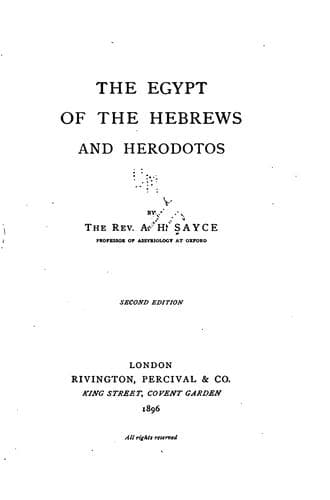
The Egypt of the Hebrews and HerodotosSayce, A. H. (Archibald Henry)
History
The Egypt of the Hebrews and Herodotos
Sayce, A. H. (Archibald Henry)
Egypt -- History, Ancient
The monuments even now contain evidence that, after the age of Hekatæos,
Greek sightseers did not make their way into southern Egypt until the
Macedonian conquest had made travel there easy and safe. At Abu-Simbel in
Nubia and Abydos in Upper Egypt are the records of the Greek mercenaries
of Psammetikhos and their Greek and Karian contemporaries who visited the
oracle of Abydos. But then comes a long blank in the history of Greek
writing in Egypt. With the foundation of Alexander’s empire a new epoch in
it begins. From that time forward the walls of the tombs and temples were
covered with the scrawls of innumerable Greek visitors. At Thebes the
royal tombs were especial objects of attention, and ciceroni led the
inquisitive stranger round them just as they do to-day.
But among all the mass of Greek names that have been collected from the
monuments of Upper Egypt we find neither that of Herodotos nor of any
other of his countrymen of the same age. In fact, it was not a time for
sightseeing in the southern valley of the Nile. The population were in
only half-repressed rebellion against their Persian rulers, and the whole
country swarmed with bandits. Persian authority was necessarily weaker
than in the north, and the people were more combative and had near allies
in the desert, the Bedouin and the Ethiopians. A voyage up the river was
even more dangerous than in the anarchical days of the last century:
pirates abounded, and out of reach of the Persian garrison at Memphis the
traveller carried his life in his hand. As in the time of Norden no
Egyptian bey could or would allow the traveller in Nubia to go south of
Dirr, so in the time of Herodotos the southern limit of the foreigner’s
travels was the Fayyûm. The “Egypt into which Greeks sail” was, as he
himself declares, the Egypt which lay north of the Theban nome and Lake
Mœris.
Even a visit to the Fayyûm was doubtless a bold and unusual undertaking,
and on this account Herodotos describes what he saw there at more than
ordinary length, and extols the wonders of the district at the expense of
the better-known monuments of Memphis and the Delta. But the Oasis had
suffered much from the civil troubles which had afflicted Egypt. The dykes
which kept out the inundation had been neglected, and the fertile nome was
transformed into a stagnant lake. Herodotos saw it as the French _savans_
saw it at the beginning of the present century; the embankments were
broken, and fields and roads were alike submerged.
Public-domain text, read in full here on John Shaqi.
Reviews
Reviews
No reviews yet
Be the first to share your thoughts on this work.
Elsewhere in the archive
Join the Discussion
Join the discussion
Sign in to leave a comment or review.
Sign InorCreate an account