The two catalogues agree to a certain extent, but they also disagree,
and the second is evidently the result of a different process of thought
than that which gave birth to the first. The author of Part I is not the
author of Part II, unless perhaps at a different and later period. Nor
is there any indication in Part I of the extraordinary examination to
which the deceased person is subjected in Part III. This in itself would
not be a serious objection, but the matter becomes more complicated if
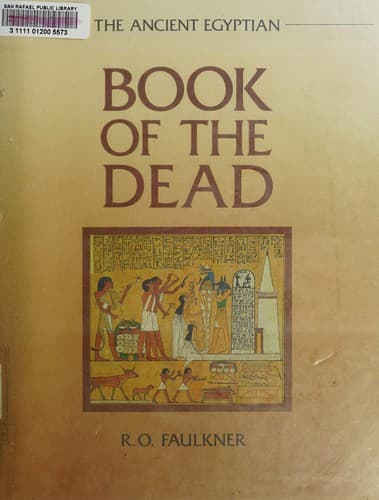
we remember that the picture of the Psychostasia has the right to be
considered as a part of the chapter. The texts which are written upon it
differ, indeed, according to the taste of the artist, and can therefore
claim no canonical authority. But the question as to the order of
succession in the trials, or the precise moment at which the deceased
person is finally freed from all anxiety as to his fate, cannot be
satisfactorily solved on the supposition that all these documents form
parts of a consistent whole. It seems much more natural to consider them
as really independent compositions brought together in consequence of
their subject matter. The artists of the Ramseside period (in the papyri
of Hunefer and Ani) add another scene[111] in which the deceased is
judged not by the forty-two assessors of Osiris but by a smaller company
of gods (twelve or fourteen), sitting on thrones and bearing the names
of well known divinities.
The essential notion was that of a trial before Osiris, in which the
man’s conduct or conscience was weighed in the Balance. This trial is
referred to in various chapters of the Book of the Dead and in other
texts which prove that, with reference to the details, free scope was
allowed to the imagination of the scribes or artists.
The number of the Forty-two assessors might be thought connected with
that of the Nomes of Egypt. But this number is only certain for the
later periods of Egyptian history, and is not true for earlier times.
Moreover the localities in which the gods are said to make their
appearances do not correspond to the nomes, or places within them. Some
of the localities occur more than once, and some of them, if not all,
are localities not upon earth. Heaven occurs twice, the eleventh god
makes his appearance at Amenta and the forty-second in the Netherworld.
But the names which have a more earthly sound may have a mystical
meaning. The first god makes his appearance in Annu, so does the
seventeenth and so does the twenty-fourth. But does this mean Heliopolis
of Egypt? On referring to an important text in Mariette’s _Monuments
Divers_, pl. 46, it will be seen that Annu is the Eastern _Solar
Mountain_ ⁂⁂⁂, where the sun rises, and where he is saluted by
the Powers of the East. There cannot be a more striking illustration of
“the Divine Babe who maketh his appearance in Annu” (the twenty-fourth
Assessor), than the _picture_ I refer to.[112]
Public-domain text, read in full here on John Shaqi.
Reviews
Reviews
No reviews yet
Be the first to share your thoughts on this work.
Elsewhere in the archive
Join the Discussion
Join the discussion
Sign in to leave a comment or review.
Sign InorCreate an account