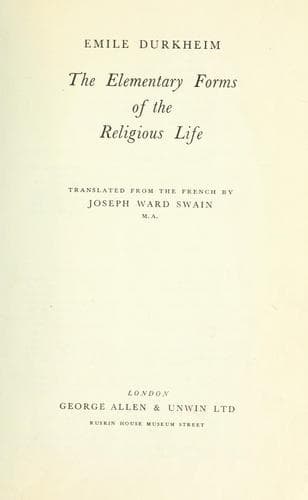
The Elementary Forms of the Religious LifeDurkheim, Émile
Religion
The Elementary Forms of the Religious Life
Durkheim, Émile
Cults; Religion; Religion -- Philosophy; Rites and ceremonies; Totemism
Finally, the totemic organization, such as we have just described it,
must obviously be the result of some sort of an indistinct understanding
between all the members of the tribe. It is impossible that each clan
should have made its beliefs in an absolutely independent manner; it is
absolutely necessary that the cults of the different totems should be in
some way adjusted to each other, since they complete one another
exactly. In fact, we have seen that normally a single totem is not
repeated twice in the same tribe, and that the whole universe is divided
up among the totems thus constituted in such a way that the same object
is not found in two different clans. So methodical a division could
never have been made without an agreement, tacit or planned, in which
the whole tribe participated. So the group of beliefs which thus arise
are partially (but only partially) a tribal affair.[487]
To sum up, then, in order to form an adequate idea of totemism, we must
not confine ourselves within the limits of the clan, but must consider
the tribe as a whole. It is true that the particular cult of each clan
enjoys a very great autonomy; we can now see that it is within the clan
that the active ferment of the religious life takes place. But it is
also true that these cults fit into each other and the totemic religion
is a complex system formed by their union, just as Greek polytheism was
made by the union of all the particular cults addressed to the different
divinities. We have just shown that, thus understood, totemism also has
it cosmology.
CHAPTER IV
TOTEMIC BELIEFS--_end_
_The Individual Totem and the Sexual Totem_
Up to the present, we have studied totemism only as a public
institution: the only totems of which we have spoken are common to a
clan, a phratry or, in a sense, to a tribe;[488] an individual has a
part in them only as a member of a group. But we know that there is no
religion which does not have an individual aspect. This general
observation is applicable to totemism. In addition to the impersonal and
collective totems which hold the first place, there are others which are
peculiar to each individual, which express his personality, and whose
cult he celebrates in private.
I
In certain Australian tribes, and in the majority of the Indian tribes
of North America,[489] each individual personally sustains relations
with some determined object, which are comparable to those which each
clan sustains with its totem. This is sometimes an inanimate being or an
artificial object; but it is generally an animal. In certain cases, a
special part of the organism, such as the head, the feet or the liver,
fulfils this office.[490]
Public-domain text, read in full here on John Shaqi.
Reviews
Reviews
No reviews yet
Be the first to share your thoughts on this work.
Elsewhere in the archive
Join the Discussion
Join the discussion
Sign in to leave a comment or review.
Sign InorCreate an account