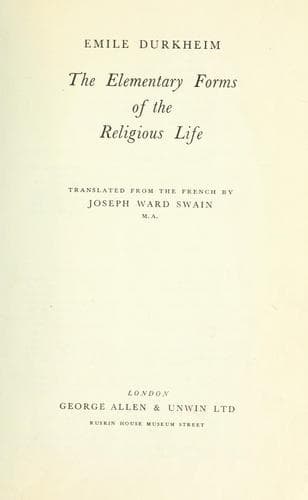
The Elementary Forms of the Religious LifeDurkheim, Émile
Religion
The Elementary Forms of the Religious Life
Durkheim, Émile
Cults; Religion; Religion -- Philosophy; Rites and ceremonies; Totemism
However, it is incontestable that in this case the idea of an impersonal
religious force is beginning to change; but there are other cases where
it is affirmed in all its abstract purity and even reaches a higher
degree of generality than in Australia. If the different totemic
principles to which the various clans of a single tribe address
themselves are distinct from each other, they are, none the less,
comparable to each other at bottom; for all play the same rôle in their
respective spheres. There are societies which have had the feeling of
this unity with nature and have consequently advanced to the idea of a
unique religious force of which all other sacred principles are only
expressions and which makes the unity of the universe. As these
societies are still thoroughly impregnated with totemism, and as they
remain entangled in a social organization identical with that of the
Australians, we may say that totemism contained this idea in
potentiality.
This can be observed in a large number of American tribes, especially
those belonging to the great Sioux family: the Omaha, Ponka, Kansas,
Osage, Assiniboin, Dakota, Iowa, Winnebago, Mandan, Hidatsa, etc. Many
of these are still organized in clans, as the Omaha[620] and the
Iowa;[621] others were so not long since, and, says Dorsey, it is still
possible to find among them "all the foundations of the totemic system,
just as in the other societies of the Sioux."[622] Now among these
peoples, above all the particular deities to whom men render a cult,
there is a pre-eminent power to which all the others have the relation
of derived forms, and which is called _wakan_.[623] Owing to the
preponderating place thus assigned to this principle in the Siouan
pantheon, it is sometimes regarded as a sort of sovereign god, or a
Jupiter or Jahveh, and travellers have frequently translated wakan by
"great spirit." This is misrepresenting its real nature gravely. The
wakan is in no way a personal being; the natives do not represent it in
a determined form. According to an observer cited by Dorsey, "they say
that they have never seen the wakanda, so they cannot pretend to
personify it."[624] It is not even possible to define it by determined
attributes and characteristics. "No word," says Riggs, "can explain the
meaning of this term among the Dakota. It embraces all mystery, all
secret power, all divinity."[625] All the beings which the Dakota
reveres, "the earth, the four winds, the sun, the moon and the stars,
are manifestations of this mysterious life and power" which enters into
all. Sometimes it is represented in the form of a wind, as a breath
having its seat in the four cardinal points and moving everything:[626]
sometimes it is a voice heard in the crashing of the thunder;[627] the
sun, moon and stars are wakan.[628] But no enumeration could exhaust
this infinitely complex idea. It is not a definite and definable power,
the power of doing this or that; it is Power in an absolute sense, with
Public-domain text, read in full here on John Shaqi.
Reviews
Reviews
No reviews yet
Be the first to share your thoughts on this work.
Elsewhere in the archive
Join the Discussion
Join the discussion
Sign in to leave a comment or review.
Sign InorCreate an account