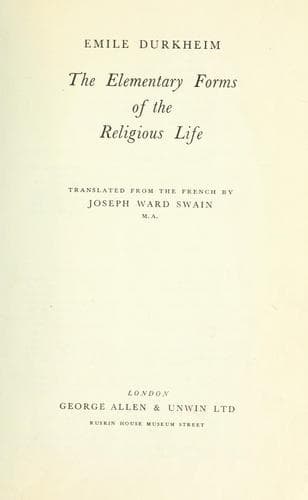
The Elementary Forms of the Religious LifeDurkheim, Émile
Religion
The Elementary Forms of the Religious Life
Durkheim, Émile
Cults; Religion; Religion -- Philosophy; Rites and ceremonies; Totemism
One characteristic fact clearly shows the fundamental reason which has
kept the idea of the mana so specialized in Australia. The real
religious forces, those thought of in the form of totems, are not the
only ones with which the Australian feels himself obliged to reckon.
There are also some over which magicians have particular control. While
the former are theoretically considered healthful and beneficent, the
second have it as their especial function to cause sickness and death.
And at the same time that they differ so greatly in the nature of their
effects, they are contrasted also by the relations which they sustain
with the social organization. A totem is always a matter of the clan;
but on the contrary, magic is a tribal and even an intertribal
institution. Magic forces do not belong to any special portion of the
tribe in particular. All that is needed to make use of them is the
possession of efficient recipes. Likewise, everybody is liable to feel
their effects and consequently should try to protect himself against
them. These are vague forces, specially attached to no determined social
division, and even able to spread their action beyond the tribe. Now it
is a remarkable fact that among the Arunta and Loritja, they are
conceived as simple aspects and particular forms of a unique force,
called in Arunta _Arungquiltha_ or _Arúnkulta_.[647] "This is a term,"
say Spencer and Gillen, "of somewhat vague import, but always associated
at bottom with the possession of _supernatural evil power_.... The name
is applied indiscriminately to the evil influence or to the object in
which it is, for the time being, or permanently, resident."[648] "By
arúnkulta," says Strehlow, "the native signifies a force which suddenly
stops life and brings death to all who come in contact with it."[649]
This name is given to the bones and pieces of wood from which
evil-working charms are derived, and also to poisonous animals and
vegetables. So it may accurately be called a harmful mana. Grey mentions
an absolutely identical notion among the tribes he observed.[650] Thus
among these different peoples, while the properly religious forces do
not succeed in avoiding a certain heterogeneity, magic forces are
thought of as being all of the same nature; the mind represents them in
their generic unity. This is because they rise above the social
organization and its divisions and subdivisions, and move in a
homogeneous and continuous space where they meet with nothing to
differentiate them. The others, on the contrary, being localized in
definite and distinct social forms, are diversified and particularized
in the image of the environment in which they are situated.
Public-domain text, read in full here on John Shaqi.
Reviews
Reviews
No reviews yet
Be the first to share your thoughts on this work.
Elsewhere in the archive
Join the Discussion
Join the discussion
Sign in to leave a comment or review.
Sign InorCreate an account