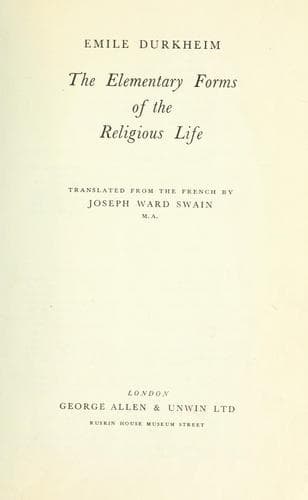
The Elementary Forms of the Religious LifeDurkheim, Émile
Religion
The Elementary Forms of the Religious Life
Durkheim, Émile
Cults; Religion; Religion -- Philosophy; Rites and ceremonies; Totemism
This conception, to which we have been led by the study of totemism
alone, has the additional recommendation that many scholars have
recently adopted it quite independently of one another, as a conclusion
from very different sorts of studies. There is a tendency towards a
spontaneous agreement on this point which should be remarked, for it is
a presumption of objectivity.
As early as 1899, we pointed out the impossibility of making the idea of
a mythical personality enter into the definition of religious
phenomena.[660] In 1900, Marrett showed the existence of a religious
phase which he called _preanimistic_, in which the rites are addressed
to impersonal forces like the Melanesian mana and the wakan of the Omaha
and Dakota.[661] However, Marrett did not go so far as to maintain that
always and in every case the idea of a spirit is logically and
chronologically posterior to that of mana and is derived from it; he
even seemed disposed to admit that it has sometimes appeared
independently and consequently, that religious thought flows from a
double source.[662] On the other hand, he conceived the mana as an
inherent property of things, as an element of their appearance; for,
according to him, this is simply the character which we attribute to
everything out of the ordinary, and which inspires a sentiment of fear
or admiration.[663] This practically amounts to a return to the naturist
theory.[664]
A little later, MM. Hubert and Mauss, while attempting to formulate a
general theory of magic, established the fact that magic as a whole
reposes on the notion of mana.[665] The close kinship of the magic rite
and the religious rite being known, it was even possible to foresee that
the same theory should be applied to religion. This was sustained by
Preuss in a series of articles in the _Globus_[666] that same year.
Relying chiefly upon facts taken from American civilizations, Preuss set
out to prove that the ideas of the soul and spirit were not developed
until after those of power and impersonal force, that the former are
only a transformation of the latter, and that up to a relatively late
date they retain the marks of their original impersonality. In fact, he
shows that even in the advanced religions, they are represented in the
form of vague emanations disengaging themselves automatically from the
things in which they reside, and even tending to escape by all the ways
that are open to them: the mouth, the nose and all the other openings of
the body, the breath, the look, the word, etc. At the same time, Preuss
pointed out their Protean forms and their extreme plasticity which
permits them to give themselves successively and almost concurrently to
the most varied uses.[667] It is true that if we stick to the letter of
the terminology employed by this author, we may believe that for him the
forces have a magic, not a religious nature: he calls them charms
(_Zauber, Zauberkräfte_). But it is evident that in expressing himself
Public-domain text, read in full here on John Shaqi.
Reviews
Reviews
No reviews yet
Be the first to share your thoughts on this work.
Elsewhere in the archive
Join the Discussion
Join the discussion
Sign in to leave a comment or review.
Sign InorCreate an account