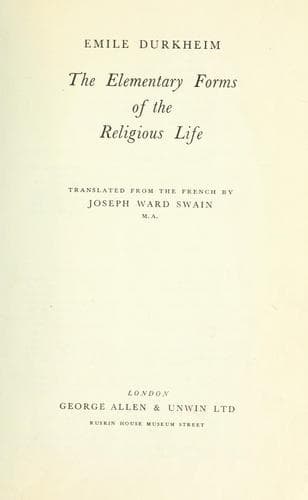
The Elementary Forms of the Religious LifeDurkheim, Émile
Religion
The Elementary Forms of the Religious Life
Durkheim, Émile
Cults; Religion; Religion -- Philosophy; Rites and ceremonies; Totemism
Since no other souls than these exist, we reach the conclusion that, in
a general way, the soul is nothing other than the totemic principle
incarnate in each individual. And there is nothing to surprise us in
this derivation. We already know that this principle is immanent in each
of the members of the clan. But in penetrating into these individuals,
it must inevitably individualize itself. Because the consciousnesses, of
which it becomes thus an integral part, differ from each other, it
differentiates itself according to their image; since each has its own
physiognomy, it takes a distinct physiognomy in each. Of course it
remains something outside of and foreign to the man, but the portion of
it which each is believed to possess cannot fail to contract close
affinities with the particular subject in which it resides; it becomes
his to a certain extent. Thus it has two contradictory characteristics,
but whose coexistence is one of the distinctive features of the notion
of the soul. To-day, as formerly, the soul is what is best and most
profound in ourselves, and the pre-eminent part of our being; yet it is
also a passing guest which comes from the outside, which leads in us an
existence distinct from that of the body, and which should one day
regain its entire independence. In a word, just as society exists only
in and through individuals, the totemic principle exists only in and
through the individual consciousnesses whose association forms the clan.
If they did not feel it in them it would not exist; it is they who put
it into things. So it must of necessity be divided and distributed among
them. Each of these fragments is a soul.
A myth which is found in a rather large number of the societies of the
centre, and which, moreover, is only a particular form of the preceding
ones, shows even better that this is really the matter out of which the
idea of the soul is made. In these tribes, tradition puts the origin of
each clan, not in a number of ancestors, but in only two,[790] or even
in one.[791] This unique being, as long as he remained single, contained
the totemic principle within him integrally, for at this moment there
was nothing to which this principle could be communicated. Now,
according to this same tradition, all the human souls which exist, both
those which now animate the bodies of men and those which are at present
unemployed, being held in reserve for the future, have issued from this
unique personage; they are made of his substance. While travelling over
the surface of the ground, or moving about, or shaking himself, he made
them leave his body and planted them in the various places he is
believed to have passed over. Is this not merely a symbolic way of
saying that they are parts of the totemic divinity?
Public-domain text, read in full here on John Shaqi.
Reviews
Reviews
No reviews yet
Be the first to share your thoughts on this work.
Elsewhere in the archive
Join the Discussion
Join the discussion
Sign in to leave a comment or review.
Sign InorCreate an account