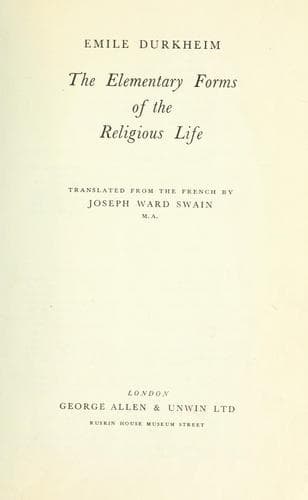
The Elementary Forms of the Religious LifeDurkheim, Émile
Religion
The Elementary Forms of the Religious Life
Durkheim, Émile
Cults; Religion; Religion -- Philosophy; Rites and ceremonies; Totemism
Just as the characteristic attributes of the mana are found in the soul,
so secondary and superficial changes are enough to enable the mana to
individualize itself in the form of a soul. We pass from the first idea
to the second with no break of continuity. Every religious force which
is attached in a special way to a determined being participates in the
characteristics of this being, takes on its appearance and becomes its
spiritual double. Tregear, in his Maori-Polynesian dictionary, has
thought it possible to connect the word _mana_ with another group of
words, such as _manawa_, _manamana_, etc., which seem to belong to the
same family, and which signify heart, life, consciousness.[862] Is this
not equivalent to saying that some sort of kinship ought to exist
between the corresponding ideas as well, that is to say, between the
idea of impersonal force and those of internal life, mental force and,
in a word, of the soul? This is why the question whether the churinga is
sacred because it serves as the residence of a soul, as Spencer and
Gillen believe, or because it has impersonal virtues, as Strehlow
thinks, seems to us to have little interest and to be without
sociological importance. Whether the efficacy of a sacred object is
represented in an abstract form in the mind or is attributed to some
personal agent does not really matter. The psychological roots of both
beliefs are identical: an object is sacred because it inspires, in one
way or another, a collective sentiment of respect which removes it from
profane touches. In order to explain this sentiment, men sometimes fall
back on to a vague and imprecise cause, and sometimes on to a determined
spiritual being endowed with a name and a history; but these different
interpretations are superadded to one fundamental phenomenon which is
the same in both cases.
Public-domain text, read in full here on John Shaqi.
Reviews
Reviews
No reviews yet
Be the first to share your thoughts on this work.
Elsewhere in the archive
Join the Discussion
Join the discussion
Sign in to leave a comment or review.
Sign InorCreate an account