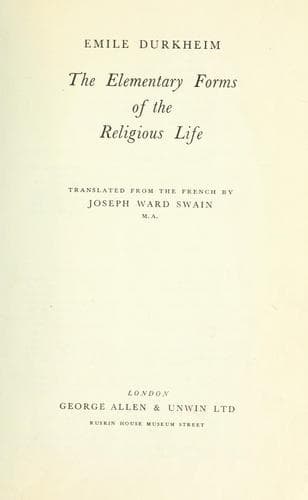
The Elementary Forms of the Religious LifeDurkheim, Émile
Religion
The Elementary Forms of the Religious Life
Durkheim, Émile
Cults; Religion; Religion -- Philosophy; Rites and ceremonies; Totemism
In fact, the soul, a symbolic representation of the personality, has the
same characteristic. Although closely bound to the body, it is believed
to be profoundly distinct from it and to enjoy, in relation to it, a
large degree of independence. During life, it may leave it temporarily,
and it definitely withdraws at death. Far from being dependent upon the
body, it dominates it from the higher dignity which is in it. It may
well take from the body the outward form in which it individualizes
itself, but it owes nothing essential to it. Nor is the autonomy which
all peoples have attributed to the soul a pure illusion; we know now
what its objective foundation is. It is quite true that the elements
which serve to form the idea of the soul and those which enter into the
representation of the body come from two different sources that are
independent of one another. One sort are made up of the images and
impressions coming from all parts of the organism; the others consist in
the ideas and sentiments which come from and express society. So the
former are not derived from the latter. There really is a part of
ourselves which is not placed in immediate dependence upon the organic
factor: this is all that which represents society in us. The general
ideas which religion or science fix in our minds, the mental operations
which these ideas suppose, the beliefs and sentiments which are at the
basis of our moral life, and all these superior forms of psychical
activity which society awakens in us, these do not follow in the trail
of our bodily states, as our sensations and our general bodily
consciousness do. As we have already shown, this is because the world of
representations in which social life passes is superimposed upon its
material substratum, far from arising from it; the determinism which
reigns there is much more supple than the one whose roots are in the
constitution of our tissues and it leaves with the actor a justified
impression of the greatest liberty. The medium in which we thus move is
less opaque and less resistant: we feel ourselves to be, and we are,
more at our ease there. In a word, the only way we have of freeing
ourselves from physical forces is to oppose them with collective forces.
But whatever we receive from society, we hold in common with our
companions. So it is not at all true that we are more personal as we are
more individualized. The two terms are in no way synonymous: in one
sense, they oppose more than they imply one another. Passion
individualizes, yet it also enslaves. Our sensations are essentially
individual; yet we are more personal the more we are freed from our
senses and able to think and act with concepts. So those who insist upon
all the social elements of the individual do not mean by that to deny or
debase the personality. They merely refuse to confuse it with the fact
of individuation.[866]
CHAPTER IX
THE IDEA OF SPIRITS AND GODS
Public-domain text, read in full here on John Shaqi.
Reviews
Reviews
No reviews yet
Be the first to share your thoughts on this work.
Elsewhere in the archive
Join the Discussion
Join the discussion
Sign in to leave a comment or review.
Sign InorCreate an account