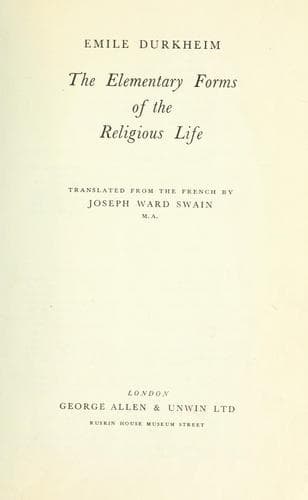
The Elementary Forms of the Religious LifeDurkheim, Émile
Religion
The Elementary Forms of the Religious Life
Durkheim, Émile
Cults; Religion; Religion -- Philosophy; Rites and ceremonies; Totemism
Thus we see how great a kinship there is between this ancestral spirit
and the _genius_ of the Latins or the [Greek: daimôn] of the
Greeks.[872] The identification of function is complete. In fact, at
first the genius is the one who begets, _qui gignit_; he expresses and
personifies the powers of generation.[873] But at the same time, he is
the protector and director of the particular individual to whose person
he is attached.[874] He is finally confused with the personality itself
of this individual; he represents the totality of the proclivities and
tendencies which characterize him and give him a distinctive appearance
among other men.[875] Hence come the well-known expressions _indulgere
genio_, _defraudere genium_ with the sense of _to follow one's natural
temperament_. At bottom, the _genius_ is another form or double of the
soul of the individual. This is proved by the partial synonomy of
_genius_ and _manes_.[876] The manes is the genius after death; but it
is also all that survives of the dead man, that is to say, his soul. In
the same way, the soul of the Arunta and the ancestral spirit which
serves as his genius are only two different aspects of one and the same
being.
But it is not only in relation to persons that the ancestor has a
definite situation; he also has one in relation to things. Though he is
believed to have his real residence under the ground, they think that he
is always haunting the place where his nanja-tree or rock is, or the
water-hole which was spontaneously formed at the exact spot where he
disappeared into the ground, having terminated his first existence. As
this tree or rock is believed to represent the body of the hero, they
imagine that the soul itself is constantly coming back there, and lives
there more or less permanently; it is by the presence of this soul that
they explain the religious respect inspired by these localities. No one
can break the branch of a nanja-tree without a risk of falling
sick.[877] "Formerly the act of breaking it down or injuring it was
punished with death. An animal or bird taking refuge there could not be
killed. Even the surrounding bushes had to be respected: the grass could
not be burned, the rocks also had to be treated with respect. It was
forbidden to remove them or break them."[878] As this sacred character
is attributed to the ancestor, he appears as the spirit of this tree or
rock, of this water-hole or spring.[879] If the spring is thought of as
having some connection with rain,[880] he will become a spirit of rain.
Thus, the same souls which serve as protecting geniuses for men also
fulfil cosmic functions at the same time. It is undoubtedly in this
sense that we must understand the text of Roth where he says that in
northern Queensland, the spirits of nature are the souls of the dead who
have chosen to live in the forests or caves.[881]
Public-domain text, read in full here on John Shaqi.
Reviews
Reviews
No reviews yet
Be the first to share your thoughts on this work.
Elsewhere in the archive
Join the Discussion
Join the discussion
Sign in to leave a comment or review.
Sign InorCreate an account