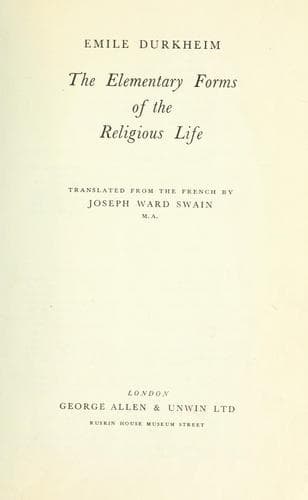
The Elementary Forms of the Religious LifeDurkheim, Émile
Religion
The Elementary Forms of the Religious Life
Durkheim, Émile
Cults; Religion; Religion -- Philosophy; Rites and ceremonies; Totemism
As we have already shown, the existence of individual souls, when once
admitted, cannot be understood unless one imagines an original supply of
fundamental souls at the origin of things, from which all the others
were derived. Now these architype souls had to be conceived as
containing within them the source of all religious efficacy; for, since
the imagination does not go beyond them, it is from them and only from
them that all sacred things are believed to come, both the instruments
of the cult, the members of the clan and the animals of the totemic
species. They incarnate all the sacredness diffused in the whole tribe
and the whole world, and so they are attributed powers noticeably
superior to those enjoyed by the simple souls of men. Moreover, time by
itself increases and reinforces the sacred character of things. A very
ancient churinga inspires much more respect than a new one, and is
supposed to have more virtues.[885] The sentiments of veneration of
which it has been the object during the series of successive generations
who have handled it are, as it were, accumulated in it. For the same
reason, the personages who for centuries have been the subject of myths
respectfully passed on from mouth to mouth, and periodically put into
action by the rites, could not fail to take a very especial place in the
popular imagination.
But how does it happen that, instead of remaining outside of the
organized society, they have become regular members of it?
This is because each individual is the double of an ancestor. Now when
two beings are related as closely as this, they are naturally conceived
as incorporated together; since they participate in the same nature, it
seems as though that which affects one ought to affect the other as
well. Thus the group of mythical ancestors became attached to the
society of the living; the same interests and the same passions were
attributed to each; they were regarded as associates. However, as the
former had a higher dignity than the latter, this association takes, in
the public mind, the form of an agreement between superiors and
inferiors, between patrons and clients, benefactors and recipients. Thus
comes this curious idea of a protecting genius who is attached to each
individual.
The question of how this ancestor came to have relations not only with
men, but also with things, may appear more embarrassing; for, at the
first glance, we do not see what connection there can be between a
personage of this sort and a rock or tree. But a fact which we owe to
Strehlow furnishes us with a solution of this problem, which is at least
probable.
Public-domain text, read in full here on John Shaqi.
Reviews
Reviews
No reviews yet
Be the first to share your thoughts on this work.
Elsewhere in the archive
Join the Discussion
Join the discussion
Sign in to leave a comment or review.
Sign InorCreate an account