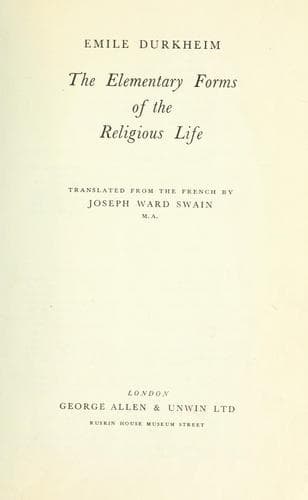
The Elementary Forms of the Religious LifeDurkheim, Émile
Religion
The Elementary Forms of the Religious Life
Durkheim, Émile
Cults; Religion; Religion -- Philosophy; Rites and ceremonies; Totemism
Moreover, the authority of each of these supreme gods is not limited to
a single tribe; it is recognized equally by a number of neighbouring
tribes. Bunjil is adored in nearly all of Victoria, Baiame in a
considerable portion of New South Wales, etc.; this is why there are so
few gods for a relatively extended geographical area. So the cults of
which they are the object have an international character. It even
happens sometimes that mythologies intermingle, combine and make mutual
borrowings. Thus the majority of the tribes who believe in Baiame also
admit the existence of Daramulun; however, they accord him a slighter
dignity. They make him a son or brother of Baiame, and subordinate to
this latter.[962] Thus the faith in Daramulun has spread in diverse
forms, into all of New South Wales. So it is far from true that
religious internationalism is a peculiarity of the most recent and
advanced religions. From the dawn of history, religious beliefs have
manifested a tendency to overflow out of one strictly limited political
society; it is as though they had a natural aptitude for crossing
frontiers, and for diffusing and internationalizing themselves. Of
course there have been peoples and times when this spontaneous aptitude
has been held in check by opposed social necessities; but that does not
keep it from being real and, as we see, very primitive.
To Tylor this conception has appeared to be a part of so elevated a
theology that he refuses to see in it anything but the product of a
European importation: he would have it be a more or less denatured
Christian idea.[963] Andrew Lang, on the contrary, considers them
autochthonous;[964] but as he also admits that it is contrasted with all
the other Australian beliefs and rests on completely different
principles, he concludes that the religions of Australia are made up of
two heterogeneous systems, superimposed one upon the other, and
consequently derived from a double origin. On the one hand, there were
ideas relative to totems and spirits, which had been suggested to men by
the sight of certain natural phenomena. But at the same time, by a sort
of intuition as to the nature of which he refuses to make himself
clear,[965] the human intelligence succeeded at the first onset in
conceiving a unique god, creator of the world and legislator of the
moral order. Lang even estimates that this idea was purer of foreign
elements at the beginning, and especially in Australia, than in the
civilizations which immediately followed. With time, it was covered over
and obscured little by little by the ever-growing mass of animistic and
totemic superstitions. Thus it underwent a sort of progressive
degeneration up to the day when, as the effect of a privileged culture,
it succeeded in coming into its own and restated itself again with more
force and clarity than it had in the first place.[966]
But the facts allow neither the sceptical hypothesis of Tylor nor the
theological interpretation of Lang.
Public-domain text, read in full here on John Shaqi.
Reviews
Reviews
No reviews yet
Be the first to share your thoughts on this work.
Elsewhere in the archive
Join the Discussion
Join the discussion
Sign in to leave a comment or review.
Sign InorCreate an account