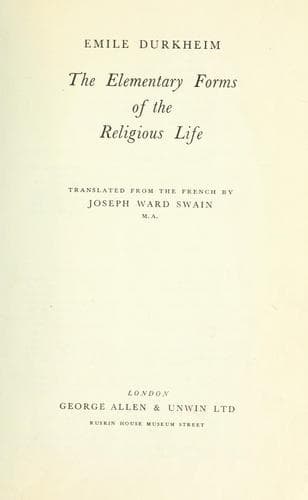
The Elementary Forms of the Religious LifeDurkheim, Émile
Religion
The Elementary Forms of the Religious Life
Durkheim, Émile
Cults; Religion; Religion -- Philosophy; Rites and ceremonies; Totemism
At the beginning of this work, we said that all the essential elements
of religious thought and life ought to be found, at least in germ, in
the most primitive religions: the preceding facts confirm this
assertion. If there is any one belief which is believed to be peculiar
to the most recent and idealistic religions, it is the one attributing a
sanctifying power to sorrow. Now this same belief is at the basis of the
rites which have just been observed. Of course, it is understood
differently at the different moments of history when it is studied. For
the Christian, it acts especially upon the soul: it purges it, ennobles
it, spiritualizes it. For the Australian, it is the body over which it
is efficient: it increases its vital energies; it makes its beard and
hair grow; it toughens its members. But in both cases the principle is
the same. In both it is admitted that suffering creates exceptional
strength. And this belief is not without foundation. In fact, it is by
the way in which he braves suffering that the greatness of a man is best
manifested. He never rises above himself with more brilliancy than when
he subdues his own nature to the point of making it follow a way
contrary to the one it would spontaneously take. By this, he
distinguishes himself from all the other creatures who follow blindly
wherever pleasure calls them; by this, he makes a place apart for
himself in the world. Suffering is the sign that certain of the bonds
attaching him to his profane environment are broken; so it testifies
that he is partially freed from this environment, and, consequently, it
is justly considered the instrument of deliverance. So he who is thus
delivered is not the victim of a pure illusion when he believes himself
invested with a sort of mastery over things: he really has raised
himself above them, by the very act of renouncing them; he is stronger
than nature, because he makes it subside.
Public-domain text, read in full here on John Shaqi.
Reviews
Reviews
No reviews yet
Be the first to share your thoughts on this work.
Elsewhere in the archive
Join the Discussion
Join the discussion
Sign in to leave a comment or review.
Sign InorCreate an account