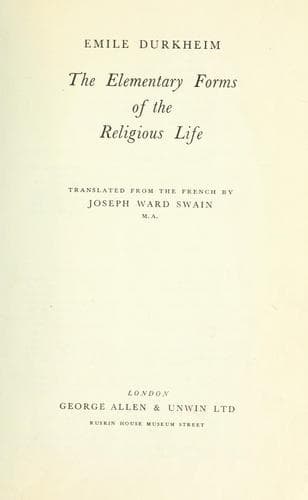
The Elementary Forms of the Religious LifeDurkheim, Émile
Religion
The Elementary Forms of the Religious Life
Durkheim, Émile
Cults; Religion; Religion -- Philosophy; Rites and ceremonies; Totemism
But this distinction is arbitrary. It is true that mythology has an
æsthetic interest as well as one for the history of religions; but it is
one of the essential elements of the religious life, nevertheless. If
the myth were withdrawn from religion, it would be necessary to withdraw
the rite also; for the rites are generally addressed to definite
personalities who have a name, a character, determined attributes and a
history, and they vary according to the manner in which these
personalities are conceived. The cult rendered to a divinity depends
upon the character attributed to him; and it is the myth which
determines this character. Very frequently, the rite is nothing more
than the myth put in action; the Christian communion is inseparable from
the myth of the Last Supper, from which it derives all its meaning. Then
if all mythology is the result of a sort of verbal delirium, the
question which we raised remains intact: the existence, and especially
the persistence of the cult become inexplicable. It is hard to
understand how men have continued to do certain things for centuries
without any object. Moreover, it is not merely the peculiar traits of
the divine personalities which are determined by mythology; the very
idea that there are gods or spiritual beings set above the various
departments of nature, in no matter what manner they may be represented,
is essentially mythical.[168] Now if all that which appertains to the
notion of gods conceived as cosmic agents is blotted out of the
religions of the past, what remains? The idea of a divinity in itself,
of a transcendental power upon which man depends and upon which he
supports himself? But that is only an abstract and philosophic
conception which has been fully realized in no historical religion; it
is without interest for the science of religions.[169] We must therefore
avoid distinguishing between religious beliefs, keeping some because
they seem to us to be true and sane and rejecting others because they
shock and disconcert us. All myths, even those which we find the most
unreasonable, have been believed.[170] Men have believed in them no less
firmly than in their own sensations; they have based their conduct upon
them. In spite of appearances, it is therefore impossible that they
should be without objective foundation.
However, it will be said that in whatever manner religions may be
explained, it is certain that they are mistaken in regard to the real
nature of things: science has proved it. The modes of action which they
counsel or prescribe to men can therefore rarely have useful effects: it
is not by lustrations that the sick are cured nor by sacrifices and
chants that the crops are made to grow. Thus the objection which we have
made to naturism would seem to be applicable to all possible systems of
explanation.
Public-domain text, read in full here on John Shaqi.
Reviews
Reviews
No reviews yet
Be the first to share your thoughts on this work.
Elsewhere in the archive
Join the Discussion
Join the discussion
Sign in to leave a comment or review.
Sign InorCreate an account