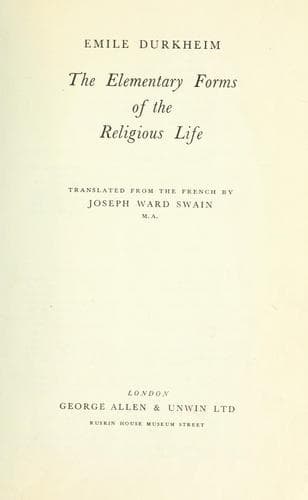
The Elementary Forms of the Religious LifeDurkheim, Émile
Religion
The Elementary Forms of the Religious Life
Durkheim, Émile
Cults; Religion; Religion -- Philosophy; Rites and ceremonies; Totemism
Each clan has its totem, which belongs to it alone; two different clans
of the same tribe cannot have the same. In fact, one is a member of a
clan merely because he has a certain name. All who bear this name are
members of it for that very reason; in whatever manner they may be
spread over the tribal territory, they all have the same relations of
kinship with one another.[217] Consequently, two groups having the same
totem can only be two sections of the same clan. Undoubtedly, it
frequently happens that all of a clan does not reside in the same
locality, but has representatives in several different places. However,
this lack of a geographical basis does not cause its unity to be the
less keenly felt.
In regard to the word totem, we may say that it is the one employed by
the Ojibway, an Algonquin tribe, to designate the sort of thing whose
name the clan bears.[218] Although this expression is not at all
Australian,[219] and is found only in one single society in America,
ethnographers have definitely adopted it, and use it to denote, in a
general way, the system which we are describing. Schoolcraft was the
first to extend the meaning of the word thus and to speak of a "totemic
system."[220] This extension, of which there are examples enough in
ethnography, is not without inconveniences. It is not normal for an
institution of this importance to bear a chance name, taken from a
strictly local dialect, and bringing to mind none of the distinctive
characteristics of the thing it designates. But to-day this way of
employing the word is so universally accepted that it would be an excess
of purism to rise against this usage.[221]
In a very large proportion of the cases, the objects which serve as
totems belong either to the animal or the vegetable kingdom, but
especially to the former. Inanimate things are much more rarely
employed. Out of more than 500 totemic names collected by Howitt among
the tribes of south-eastern Australia, there are scarcely forty which
are not the names of plants or animals; these are the clouds, rain,
hail, frost, the moon, the sun, the wind, the autumn, the summer, the
winter, certain stars, thunder, fire, smoke, water or the sea. It is
noticeable how small a place is given to celestial bodies and, more
generally, to the great cosmic phenomena, which were destined to so
great a fortune in later religious development. Among all the clans of
which Howitt speaks, there were only two which had the moon as
totem,[222] two the sun,[223] three a star,[224] three the thunder,[225]
two the lightning.[226] The rain is a single exception; it, on the
contrary, is very frequent.[227]
Public-domain text, read in full here on John Shaqi.
Reviews
Reviews
No reviews yet
Be the first to share your thoughts on this work.
Elsewhere in the archive
Join the Discussion
Join the discussion
Sign in to leave a comment or review.
Sign InorCreate an account