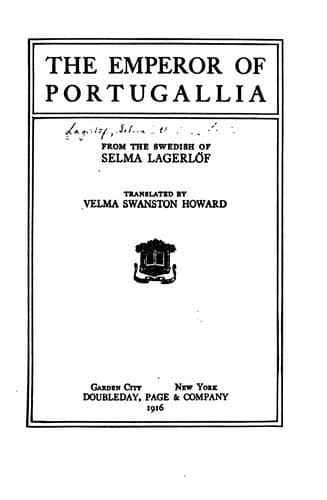
Fathers and daughters -- Fiction; Sweden -- Fiction; Swedish fiction -- Translations into English
But now that the little girl had come up in the world, it was
altogether different with him. He felt that it would be a great
disappointment to Lieutenant Liljecrona if so exalted a personage
as the Emperor Johannes of Portugallia did not do him the honour of
wishing him happiness on his birthday.
So he donned his imperial regalia and sallied forth, taking good
care not to be among the first arrivals. For him who was an emperor
it was the correct thing not to put in an appearance until all the
guests had made themselves quite at home, and the festivities were
well under way.
Upon the occasion of his former visit he had not ventured farther
than the orchard and the gravelled walk in front of the house. He
had not even gone up to pay his respects to the host. But now he
could not think of behaving so discourteously.
This time he made straight for the big bower at the left of the
porch, where the lieutenant sat with a group of dignitaries from
Svartsjö and elsewhere, grasped him by the hand, and wished him
many happy returns of the day.
"So you've come out to-day, Jan," said the lieutenant in a tone of
surprise.
To be sure he was not expecting an honour like this, which probably
accounted for his so far forgetting himself as to address the
Emperor by his old name. Jan knew that so genial a man as the
lieutenant could have meant no offense by that, therefore he
corrected him in all meekness.
"We must make allowances for the lieutenant," he said, "since this
is his birthday; but by rights we should be called Emperor Johannes
of Portugallia."
Jan spoke in the gentlest tone possible, but just the same the
other gentlemen all laughed at the lieutenant for having made such
a bad break. Jan had never intended to cause him humiliation on his
birthday, so he promptly dismissed the matter and turned to the
others. Raising his cap with an imperial flourish, he said:
"Go'-day, go'-day, my worthy Generals and Bishops and Governors."
It was his intention to go around and shake hands with everybody,
as one is expected to do at a party.
Nearest the lieutenant sat a short, stocky man in a white cloth
jacket, with a gold-trimmed collar, and a sword at his side, who,
when Jan stepped up to greet him did not offer his whole hand, but
merely held out two fingers. The man's intentions may have been all
right, but of course a potentate like Emperor Johannes of
Portugallia knew he must stand upon his dignity.
"I think you will have to give me your whole hand, my good Bishop
and Governor," he said very pleasantly, for he did not want to
disturb the harmony on this great day.
Then, mind you, the man turned up his nose!
"I have just heard it was not to your liking that Liljecrona called
you by name," he observed, "and I wonder how you can have the
audacity to say _du_ [Note: Du like the French "tu" is used only in
addressing intimates.] to me!" Then, pointing to three poor little
yellow stars that were attached to his coat, he roared: "See
these?"
Public-domain text, read in full here on John Shaqi.
Reviews
Reviews
No reviews yet
Be the first to share your thoughts on this work.
Elsewhere in the archive
Join the Discussion
Join the discussion
Sign in to leave a comment or review.
Sign InorCreate an account