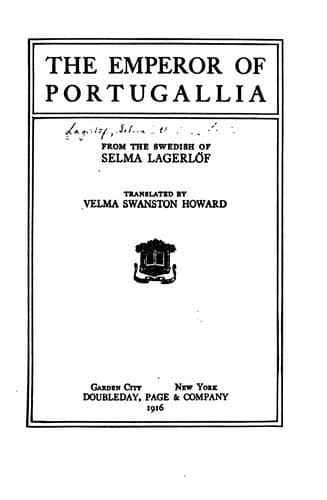
Fathers and daughters -- Fiction; Sweden -- Fiction; Swedish fiction -- Translations into English
"At any rate, he doesn't seem to be working now," said Lady
Liljecrona. "I have heard that he only runs about from place to
place, showing his stars and singing."
Lady Liljecrona was a serious-minded and dutiful woman who liked
industrious and capable folk like Katrina of Ruffluck. She had
sympathy for her and wanted to show it. But Katrina continued to
stand up for her husband.
"He is old and has had much sorrow these last years. He has need of
a little freedom, after a lifetime of hard toil."
"It's well you can take your misfortune so calmly," observed Lady
Liljecrona somewhat sharply. "But I really think that you, with
your good sense, should try to take out of Jan the ridiculous
nonsense that has got into his head. You see, if this is allowed to
go on it will end in his being shut up in a madhouse."
Now Katrina squared her shoulders and looked highly indignant.
"Jan is not crazy," she said. "But Our Lord has placed a shade
before his eyes so he'll not have to see what he couldn't bear
seeing. And for that one can only feel thankful."
Lady Liljecrona did not wish to appear contentious. She thought it
only right and proper for a wife to stand by her husband.
"Then, Katrina, everything is all right as it is," she said
pleasantly. "And don't forget that here you will find work enough
to keep you going the year around."
And then Lady Liljecrona saw the stern, set old face in front of
her soften and relax: all that had been bound in and held back gave
way--grief and solicitude and love came breaking through, and the
eyes overflowed.
"My only happiness is to work for him," said the old woman. "He has
become so wonderful with the years that he's something more than
just human. But for that I suppose they'll come and take him away
from me."
BOOK FOUR
THE WELCOME GREETING
She had come! The little girl had come! It is hard to find words to
describe so great an event.
She did not arrive till late in the autumn, when the passenger
boats that ply Lake Löven had discontinued their trips for the
season and navigation was kept up by only two small freight
steamers. But on either of these she had not cared to travel--or
perhaps she had not even known about them. She had come by wagon
from the railway station to the Ashdales.
So after all Jan of Ruffluck did not have the pleasure of welcoming
his daughter at the Borg pier, where for fifteen years he had
awaited her coming. Yes, it was all of fifteen years that she had
been away. For seventeen years she had been the light and life of
his home, and for almost as long a time had he missed her.
Public-domain text, read in full here on John Shaqi.
Reviews
Reviews
No reviews yet
Be the first to share your thoughts on this work.
Elsewhere in the archive
Join the Discussion
Join the discussion
Sign in to leave a comment or review.
Sign InorCreate an account