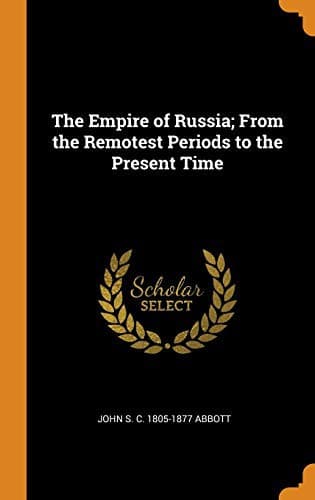
The Empire of Russia: From the Remotest Periods to the Present TimeAbbott, John S. C. (John Stevens Cabot)
History
The Empire of Russia: From the Remotest Periods to the Present Time
Abbott, John S. C. (John Stevens Cabot)
Russia -- History
About the middle of October the two armies met upon the opposite banks
of the Oka, with only the waters of that narrow stream to separate
them. Cannon and muskets were then just coming into use, but they were
rude and feeble instruments compared with the power of such weapons at
the present day. Swords, arrows, javelins, clubs, axes, battering-rams
and catapults, and the tramplings of horse were the engines of
destruction which man then wielded most potently against his
fellow-man. The quarrel was a very simple one. Some hundreds of
thousands of Mogols had marched to the heart of Russia, leaving behind
them a path of flame and blood nearly a thousand miles in length, that
they might compel the Russians to pay them tribute. Some hundred
thousand Russians had met them there, to resist even to death their
insolent and oppressive demand.
The Tartars were far superior in numbers to the Russians, but Ivan had
made such a skillful disposition of his troops that Akhmet could not
cross the stream. For nearly a week the two armies fought from the
opposite banks, throwing at each other bullets, balls, stones, arrows
and javelins. A few were wounded and some slain in this impotent
warfare.
The Russians were, however, very faint-hearted. It was evident that,
should the Tartars effect the passage of the river, the Russians,
already demoralized by fear, would be speedily overpowered. The grand
prince himself was so apprehensive as to the result, that he sent one
of his nobles with rich presents to the khan and proposed terms of
peace. Akhmet rejected the presents, and sent back the haughty reply:
"I have come thus far to take vengeance upon Ivan; to punish him for
neglecting for nine years to appear before me with tribute and in
homage. Let him come penitently into my presence and kiss my stirrup,
and then perhaps, if my lords intercede for him, I may forgive him."
As soon as it was heard in Moscow that the grand prince was
manifesting such timidity, the clergy sent to him a letter urging the
vigorous defense of their country and of their religion. The letter
was written by Vassian, the archbishop of Moscow, and was signed, on
behalf of the clergy, by several of the higher ecclesiastics. We have
not space to introduce the whole of this noble epistle, which is
worthy of being held in perpetual remembrance. The following extracts
will show its spirit. It was in the form of a letter from the
archbishop to the king; to which letter others of the clergy gave
their assent:
Public-domain text, read in full here on John Shaqi.
Reviews
Reviews
No reviews yet
Be the first to share your thoughts on this work.
Elsewhere in the archive
Join the Discussion
Join the discussion
Sign in to leave a comment or review.
Sign InorCreate an account