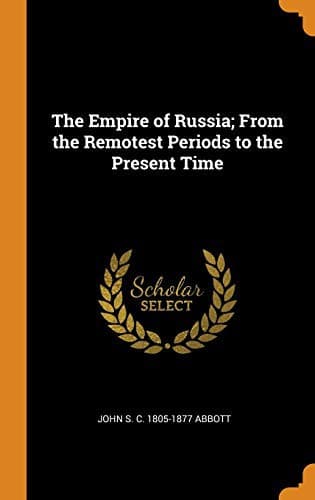
The Empire of Russia: From the Remotest Periods to the Present TimeAbbott, John S. C. (John Stevens Cabot)
History
The Empire of Russia: From the Remotest Periods to the Present Time
Abbott, John S. C. (John Stevens Cabot)
Russia -- History
As the sun rose, an unprecedented spectacle was presented. Two
immense armies were flying from each other in indescribable confusion
and dismay, each actually frightened out of its wits, and no one
pursuing either. The Russians did not stop for a long breath until
they attained the walls of Moscow. Akhmet, having reached the head
waters of the Don, retreated rapidly down that stream, wreaking such
vengeance as he could by the way, but not venturing to stop until he
had reached his strongholds upon the banks of the Volga. Thus,
singularly, _providentially_, terminated this last serious invasion of
Russia by the Tartars. A Russian annalist, in attributing the glory of
this well-authenticated event all to God, writes: "Shall men, vain and
feeble, celebrate the terror of their arms? No! it is not to the might
of earth's warriors, it is not to human wisdom that Russia owes her
safety, but only to the goodness of God."
Ivan III., in the cathedrals of Moscow, offered long continued praises
to God for this victory, obtained without the effusion of blood. An
annual festival was established in honor of this great event. Akhmet,
with his troops disorganized and scattered, had hardly reached the
Volga, ere he was attacked by a rival khan, who drove him some five
hundred miles south to the shore of the Sea of Azof. Here his rival
overtook him, killed him with his own hand, took his wives and his
daughters captives, seized all his riches, and then, seeking friendly
relations with Russia, sent word to Moscow that the great enemy of the
grand prince was in his grave.
Thus terminated for ever the sway of the Tartars over the Russians.
For two hundred years, Russia had been held by the khans in slavery.
Though the horde long continued to exist as a band of lawless and
uncivilized men, often engaged in predatory excursions, no further
attempts were made to exact either tribute or homage.
CHAPTER XI.
THE REIGN OF VASSILI
From 1480 to 1533.
Alliance With Hungary.--A Traveler From Germany.--Treaty Between
Russia and Germany.--Embassage To Turkey.--Court Etiquette.--Death of
the Princess Sophia.--Death of Ivan.--Advancement of
Knowledge.--Succession of Vassili.--Attack Upon the Horde.--Rout of
the Russians.--The Grand Prince Takes the Title of Emperor.--Turkish
Envoy To Moscow.--Efforts To Arm Europe Against the Turks.--Death of
the Emperor Maximilian, and Accession of Charles V. To the Empire of
Germany.--Death of Vassili.
Public-domain text, read in full here on John Shaqi.
Reviews
Reviews
No reviews yet
Be the first to share your thoughts on this work.
Elsewhere in the archive
Join the Discussion
Join the discussion
Sign in to leave a comment or review.
Sign InorCreate an account