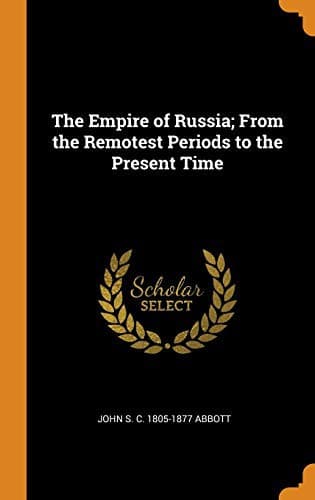
The Empire of Russia: From the Remotest Periods to the Present TimeAbbott, John S. C. (John Stevens Cabot)
History
The Empire of Russia: From the Remotest Periods to the Present Time
Abbott, John S. C. (John Stevens Cabot)
Russia -- History
In the year 1514, Vassili, entering into a treaty with Maximilian, the
Emperor of Germany, laid aside the title of grand prince and assumed
for himself that of emperor, which was _Kayser_ in the German language
and _Tzar_ in the Russian. With great energy Vassili pushed the work
of concentrating and extending his empire, every year strengthening
his power over the distant principalities. Bajazet II., the Turkish
sultan, the victim of a conspiracy, was dethroned by his son Selim.
Vassili, wishing, for the sake of commerce, to maintain friendly
relations with Turkey, sent an embassador to the new sultan. The
embassador, Alexeief, was authorized to make all proper protestations
of friendship, but to be very cautious not to compromit the dignity of
his sovereign. He was instructed not to prostrate himself before the
sultan, as was the oriental custom, but merely to offer his hands. He
was to convey rich presents to Selim, with a letter from the Russian
court, but was by no means to enquire for the health of the sultan,
unless the sultan should first enquire for the health of the emperor.
Notwithstanding these chilling punctilios, Selim received the Russian
embassador with much cordiality, and sent back with him a Turkish
embassador to the court of Moscow. Nine months, from August to May,
were occupied in the weary journey. While traversing the vast deserts
of Veronage, their horses, exhausted and starving, sank beneath them,
and they were obliged to toil along for weary leagues on foot,
suffering from the want both of food and water. They nearly perished
before reaching the frontiers of Rezan, but here they found horses and
retinue awaiting them, sent by Vassili. Upon their arrival at Moscow,
the Turkish embassador was received with great enthusiasm. It was
deemed an honor, as yet unparalleled in Russia, that the terrible
conquerors of Constantinople, before whose arms all Christendom was
trembling, should send an embassador fifteen hundred miles to Moscow
to seek the alliance of the emperor.
The Turkish envoy was received with great magnificence by Vassili,
seated upon his throne, and surrounded by his nobles clad in robes of
the most costly furs. The embassador, Theodoric Kamal, a Greek by
birth, with the courtesy of the polished Greek, kneeling, kissed the
hand of the emperor, presented him the letter of his master, the
sultan, beautifully written upon parchment in Arabic letters, and
assured the emperor of the wish of the sultan to live with him in
eternal friendship. But the Turk, loud in protestations, was not
disposed to alliance. It was evident that the office of a spy
constituted the most important part of the mission of Kamal.
This embassador had but just left the court of Moscow when another
appeared, from the Emperor Maximilian, of Germany. The message with
which the Baron Herberstein was commissioned from the court of Vienna
to the court of Moscow is sufficiently important to be recorded.
Public-domain text, read in full here on John Shaqi.
Reviews
Reviews
No reviews yet
Be the first to share your thoughts on this work.
Elsewhere in the archive
Join the Discussion
Join the discussion
Sign in to leave a comment or review.
Sign InorCreate an account