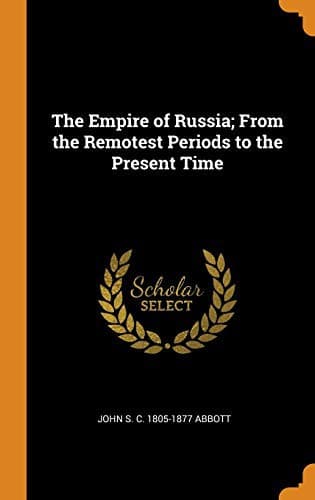
The Empire of Russia: From the Remotest Periods to the Present TimeAbbott, John S. C. (John Stevens Cabot)
History
The Empire of Russia: From the Remotest Periods to the Present Time
Abbott, John S. C. (John Stevens Cabot)
Russia -- History
Following the example of Ivan III., Vassili was unwearied in his
endeavors to induce foreigners of distinction, particularly artists,
physicians and men of science, to take up their residence in Russia.
Any stranger, distinguished for genius or capability of any kind, who
entered Russia, found it not easy to leave the kingdom. A Greek
physician, of much celebrity, from Constantinople, visited Moscow.
Vassili could not find it in his heart to relinquish so rich a prize,
and detained him with golden bonds, which the unhappy man, mourning
for his wife and children, in vain endeavored to break away. At last
the sultan was influenced to write in behalf of the Greek.
"Permit," he wrote, "Marc to return to Constantinople to rejoin his
family. He went to Russia only for a temporary visit."
The emperor replied:
"For a long time Marc has served me to his and my perfect
satisfaction. He is now my lieutenant at Novgorod. Send to him his
wife and children."
The power of the sovereign was absolute. His will was the supreme law.
The lives, the fortunes of the clergy, the laity, the lords, the
citizens were dependent upon his pleasure. The Russians regarded their
monarch as the executor of the divine will. Their ordinary language
was, _God and the prince decree it_. The Russians generally defend
this _autocracy_ as the only true principle of government. The
philosophic Karamsin writes:
"Ivan III. and Vassili knew how to establish permanently the nature of
one government by constituting in _autocracy_ the necessary attribute
of empire, its sole constitution, and the only basis of safety, force
and prosperity. This limitless power of the prince is regarded as
_tyranny_ in the eye of strangers, because, in their inconsiderate
judgment, they forget that _tyranny_ is the abuse of autocracy, and
that the same tyranny may exist in a republic when citizens or
powerful magistrates oppress society. Autocracy does not signify the
absence of laws, since law is everywhere where there is any duty to be
performed, and the first duty of princes, is it not to watch over the
happiness of their people?"
Public-domain text, read in full here on John Shaqi.
Reviews
Reviews
No reviews yet
Be the first to share your thoughts on this work.
Elsewhere in the archive
Join the Discussion
Join the discussion
Sign in to leave a comment or review.
Sign InorCreate an account