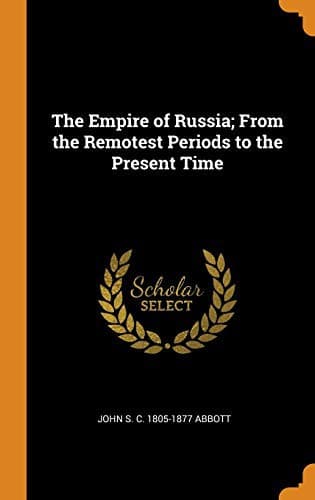
The Empire of Russia: From the Remotest Periods to the Present TimeAbbott, John S. C. (John Stevens Cabot)
History
The Empire of Russia: From the Remotest Periods to the Present Time
Abbott, John S. C. (John Stevens Cabot)
Russia -- History
The proposition, sustained by such views, was accepted with general
acclaim. There were several nobles from Castroma who testified that
though they were not personally acquainted with young Romanow, they
believed him to be a youth of unusual intelligence, discretion and
moral worth. As the nobles were anxious not to act hastily in a matter
of such great importance, they dispatched two of their number to
Castroma with a letter to the mother of Michael, urging her to repair
immediately with her son to Moscow.
The affectionate, judicious mother, upon the reception of this letter,
burst into tears of anguish, lamenting the calamity which was
impending.
"My son," she said, "my only son is to be taken from me to be placed
upon the throne, only to be miserably slaughtered like so many of the
tzars who have preceded him."
She wrote to the electors entreating them that her son might be
excused, saying that he was altogether too young to reign, that his
father was a prisoner in Poland, and that her son had no relations
capable of assisting him with their advice. This letter, on the whole,
did but confirm the assembly of nobles in their conviction that they
could not make a better choice than that of the young Romanow. They
accordingly, with great unanimity, elected Michael Feodor Romanow,
sovereign of all the Russias; then, repairing in a body to the
cathedral, they proclaimed him to the people as their sovereign. The
announcement was received with rapturous applause. It was thus that
the house of Romanow was placed upon the throne of Russia. It retains
the throne to the present day.
Michael, incited by singular sagacity and by true Christian
philanthropy, commenced his reign by the most efficient measures to
secure the peace of the empire. As soon as he had notified his
election to the King of Poland, his father, archbishop of Rostow, was
set at liberty and sent home. He was immediately created by his son
patriarch of all Russia, an office in the Greek church almost
equivalent to that of the pope in the Romish hierarchy. While these
scenes were transpiring, Charles IX. died, and Gustavus Adolphus
succeeded to the throne of Sweden. Gustavus and Michael both desired
peace, the preliminaries were soon settled, and peace was established
upon a basis far more advantageous to the Swedes than to the Russians.
By this treaty, Russia ceded to Sweden territory, which deprived
Russia of all access to the Baltic Sea. Thus the only point now upon
which Russia touched the ocean, was on the North Sea. No enemies
remained to Russia but the Poles. Here there was trouble enough.
Ladislaus still demanded the throne, and invaded the empire with an
immense army. He advanced, ravaging the country, even to the gates of
Moscow. But, finding that he had no partisans in the kingdom, and that
powerful armies were combining against him, he consented to a truce
for fourteen years.
Public-domain text, read in full here on John Shaqi.
Reviews
Reviews
No reviews yet
Be the first to share your thoughts on this work.
Elsewhere in the archive
Join the Discussion
Join the discussion
Sign in to leave a comment or review.
Sign InorCreate an account