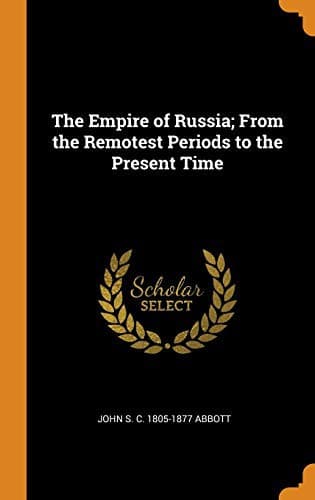
The Empire of Russia: From the Remotest Periods to the Present TimeAbbott, John S. C. (John Stevens Cabot)
History
The Empire of Russia: From the Remotest Periods to the Present Time
Abbott, John S. C. (John Stevens Cabot)
Russia -- History
Feodor had always been of an exceedingly frail constitution, and it
was evident that he could not anticipate long life. In the year 1681
he married a daughter of one of the nobles. His bride, Opimia
Routoski, was also frail in health, though very beautiful. Six months
had hardly passed away ere the youthful empress exchanged her bridal
robes and couch for the shroud and the tomb. The emperor himself,
grief-stricken, was rapidly sinking in a decline. His ministers almost
forced him to another immediate marriage, hoping that, by the birth
of a son, the succession of his half brother Peter might be prevented.
The dying emperor received into his emaciate, feeble arms the new
bride who had been selected for him, Marva Matweowna, and after a few
weeks of languor and depression died. He was deeply lamented by his
subjects, for during his short reign of less than three years he had
developed a noble character, and had accomplished more for the real
prosperity of Russia than many a monarch in the longest occupation of
the throne.
Feodor left two brothers--Ivan, a brother by the same mother, Eudocia,
and Peter, the son of the second wife of Alexis. Ivan was very feeble
in body and in mind, with dim vision, and subject to epileptic fits.
Feodor consequently declared his younger brother Peter, who was but
ten years of age, his successor. The custom of the empire allowed him
to do this, and rendered this appointment valid. It was generally the
doom of the daughters of the Russian emperors, who could seldom find a
match equal to their rank, to pass their lives immured in a convent.
Feodor had a sister, Sophia, a very spirited, energetic woman,
ambitious and resolute, whose whole soul revolted against such a
moping existence. Seeing that Feodor had but a short time to live, she
left her convent and returned to the Kremlin, persisting in her
resolve to perform all sisterly duties for her dying brother. Ivan,
her own brother, was incapable of reigning, from his infirmities.
Peter, her half-brother, was but a child. Sophia, with wonderful
energy, while tending at the couch of Feodor, made herself familiar
with the details of the administration, and, acting on behalf of the
dying sovereign, gathered the reins of power into her own hands.
As soon as Feodor expired, and it was announced that Peter was
appointed successor to the throne, to the exclusion of his elder
brother Ivan, Sophia, through her emissaries, excited the militia of
the capital to one of the most bloody revolts Moscow had ever
witnessed. It was her intention to gain the throne for the imbecile
Ivan, as she doubted not that she could, in that event, govern the
empire at her pleasure. Peter, child as he was, had already developed
a character of self-reliance which taught Sophia that he would
speedily wrest the scepter from her hands.
Public-domain text, read in full here on John Shaqi.
Reviews
Reviews
No reviews yet
Be the first to share your thoughts on this work.
Elsewhere in the archive
Join the Discussion
Join the discussion
Sign in to leave a comment or review.
Sign InorCreate an account