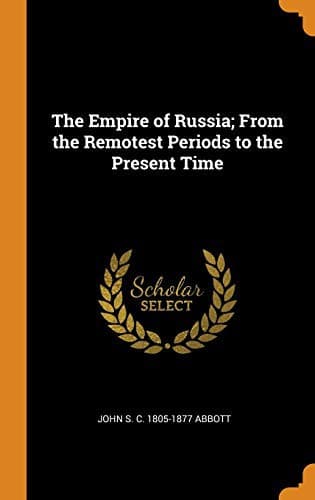
The Empire of Russia: From the Remotest Periods to the Present TimeAbbott, John S. C. (John Stevens Cabot)
History
The Empire of Russia: From the Remotest Periods to the Present Time
Abbott, John S. C. (John Stevens Cabot)
Russia -- History
This document was then taken to the cathedral, where all the higher
ecclesiastics had been assembled, and was read to them. Nothing was
omitted which could invest the act with solemnity, There is every
evidence that the heart of the father was rent with acutest anguish in
all these proceedings. Nothing could have been more desirable to him
than to transmit the empire his energies had rendered so illustrious,
to his own son to carry on the enterprises his father had commenced.
But to place eighteen millions of people in the hands of one who had
proved himself so totally unworthy, would have been the greatest
cruelty. The exclusion of Alexis from the succession was the noblest
act of Peter's life.
But new facts were soon developed which rendered it impossible for the
unhappy father to stop even here. Evidence came to light that Alexis
had been plotting a conspiracy for the dethronement of his father, and
for the seizure of the crown by violence. His mother, whom the tzar
had repudiated, and his energetic aunt, Mary, both of whom were in a
convent, were involved in the plot. He had applied to his
brother-in-law, the Emperor of Germany, for foreign troops to aid him.
There were many restless spirits in the empire, turbulent and
depraved, the boon companions of Alexis, who were ready for any deeds
of desperation which might place Alexis on the throne. The second son
of the emperor, the child of Catharine, was an infant of but a few
months old. The health of Peter was infirm and his life doubtful. It
was manifest that immediately upon the death of the tzar, Alexis would
rally his accomplices around him, raise the banner of revolt against
the infant king, and that thus the empire would be plunged into all
the horrors of a long and bloody civil war.
Peter having commenced the work of self-sacrifice for the salvation of
Russia, was not disposed to leave that work half accomplished. All
knew that the infamous Alexis would shrink from no crime, and there
was ample evidence of his treasonable plots. The father now
deliberately resolved to arraign his son for high treason, a crime
which doomed him to death. Aware of the awful solemnity of such a
moment, and of the severity with which his measures and his motives
would be sifted by posterity, he proceeded with the greatest,
circumspection. A high court of justice was organized for the trial,
consisting of two chambers, the one ecclesiastical, the other secular.
On the 13th of June, 1718, the court was assembled, and the tzar
presented to them the documentary evidence, which had been carefully
obtained, of his son's treasonable designs, and thus addressed them:
Public-domain text, read in full here on John Shaqi.
Reviews
Reviews
No reviews yet
Be the first to share your thoughts on this work.
Elsewhere in the archive
Join the Discussion
Join the discussion
Sign in to leave a comment or review.
Sign InorCreate an account