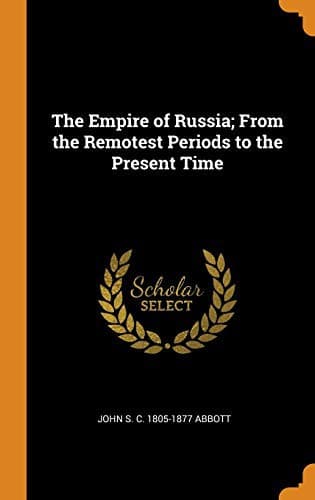
The Empire of Russia: From the Remotest Periods to the Present TimeAbbott, John S. C. (John Stevens Cabot)
History
The Empire of Russia: From the Remotest Periods to the Present Time
Abbott, John S. C. (John Stevens Cabot)
Russia -- History
About six o'clock in the evening the wretched Alexis breathed his
last, and passed from the tribunals of earth to the judgment-seat of
God. The emperor immediately seemed to banish from his mind every
remembrance of his crimes, and his funeral was attended with all the
customary demonstrations of affection and respect. Peter, fully aware
that this most momentous event of his life would be severely
criticised throughout the world, sent a statement of the facts to all
the courts of Europe. In his letter, which accompanied these
statements, he says:
"While we were debating in our mind between the natural emotions of
paternal clemency on one side, and the regard we ought to pay to the
preservation and the future security of our kingdom on the other, and
pondering what resolution to take in an affair of so great difficulty
and importance, it pleased the Almighty God, by his especial will and
his just judgment, and by his mercy to deliver us out of that
embarrassment, and to save our family and kingdom from the shame and
the dangers by abridging the life of our said son Alexis, after an
illness with which he was seized as soon as he had heard the sentence
of death pronounced against him.
"That illness appeared at first like an apoplexy; but he afterwards
recovered his senses and received the holy sacraments; and having
desired to see us, we went to him immediately, with all our counselors
and senators; and then he acknowledged and sincerely confessed all his
said faults and crimes, committed against us, with tears and all the
marks of a true penitent, and begged our pardon, which, according to
Christian and paternal duty, we granted him; after which on the 7th
of July, at six in the evening, he surrendered his soul to God."
The tzar endeavored to efface from his memory these tragic scenes by
consecrating himself, with new energy, to the promotion of the
interests of Russia. Utterly despising all luxurious indulgence, he
lived upon coarse fare, occupied plainly-furnished rooms, dressed in
the extreme of simplicity and devoted himself to daily toil with
diligence, which no mechanic or peasant in the realm could surpass.
The war still continued with Sweden. On the night of the 29th of
November, of this year, 1718, the madman Charles XII. was instantly
killed by a cannon ball which carried away his head as he was leaning
upon a parapet, in the siege of Fredericshall in Norway. The death of
this indomitable warrior quite changed the aspect of European affairs.
New combinations of armies arose and new labyrinths of intrigue were
woven, and for several years wars, with their usual successes and
disasters, continued to impoverish and depopulate the nations of
Europe. At length the tzar effected a peace with Sweden, that kingdom
surrendering to him the large and important provinces of Livonia,
Esthonia, Ingria and Carelia. This was an immense acquisition for
Russia.
Public-domain text, read in full here on John Shaqi.
Reviews
Reviews
No reviews yet
Be the first to share your thoughts on this work.
Elsewhere in the archive
Join the Discussion
Join the discussion
Sign in to leave a comment or review.
Sign InorCreate an account