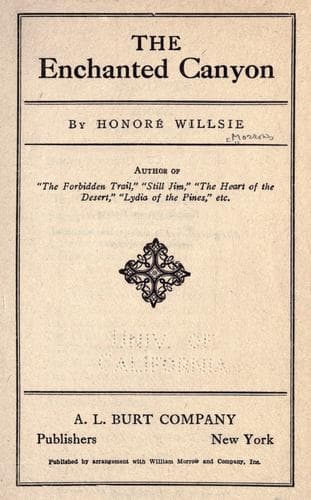
Arizona -- Fiction; Grand Canyon (Ariz.) -- Fiction; Western stories
He was wakened at dusk by the soft nuzzling of the pony against his
shoulder.
"By Jove!" he exclaimed softly. "What a sleep!" He jumped to his feet
and began to gather wood for his fire. He was stiff and his
unaccustomed fingers made awkward work of cooking, but he managed,
after an hour's endeavor, to produce an unsavory meal, which he
devoured hungrily. He wiped out the frying pan with dried grass,
repacked his outfit, and hung it on the horse.
"It's up to you, Pablo, old boy, to get us to water, if you want any
to-night," he said, as he mounted, and headed Pablo north on the trail.
The pony was quite of Enoch's opinion, and he started forward at an
eager trot. The trail was discernible enough in the starlight, but
Enoch made no attempt to guide Pablo, who obviously knew the country
better than his new owner.
Enoch had dreamed of Diana, and now, the reins drooping limply from his
hands, he gave his mind over to thought of her. There was no one on
earth whom he desired to see so much or so little as Diana! No one
else to whom in his trouble his whole heart and mind turned with such
unutterable longing or such iron determination never to see again. He
had no intention of searching for her in the desert. He knew that her
work would keep her in the Grand Canyon country. He knew that it would
be easy to avoid her. And, in spite of the fact that every fiber of
his being yearned for her, he had not the slightest desire to see her!
She would, he knew, see the Brown story. No matter what her father may
have told her, the newspaper story, with its vile innuendoes concerning
his adult life, must sicken her. There was one peak of shame which
Enoch refused to achieve. He would not submit himself either to
Diana's pity or to her scorn. But there was, he was finding, a
peculiar solace in merely traveling in Diana's desert. He had complete
faith that here he would find something of the sweet philosophy that
had written itself in Diana's face.
For Enoch had not come to middle life without learning that on a man's
philosophy rests his ultimate chance for happiness, or if not for
happiness, content. He knew that until he had sorted and separated
from each other the things that mattered and the things that did not
matter, he must be the restless plaything of circumstance. In his
younger days he had been able to persuade himself that if his point of
view on his life work were right and sane, nothing else could hurt him
too much. But now, easing himself to the pony's gentle trot and
staring into the exquisite blue silence of the desert night, he told
himself that he had been a coward, and that his cowardice had made him
shun the only real experience of life.
Public-domain text, read in full here on John Shaqi.
Reviews
Reviews
No reviews yet
Be the first to share your thoughts on this work.
Elsewhere in the archive
Join the Discussion
Join the discussion
Sign in to leave a comment or review.
Sign InorCreate an account