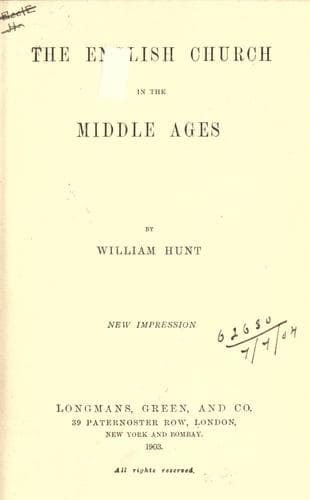
The English Church in the Middle AgesHunt, William
History
The English Church in the Middle Ages
Hunt, William
Church history -- Middle Ages, 600-1500; Great Britain -- Church history
When Richard died in 1234, Gregory confirmed this precedent by quashing
three successive elections of the chapter, and compelling the monks to
accept Edmund Rich. Edmund had been famous as a teacher at Oxford; he was
pious, and had considerable political talent. He saw with indignation the
overwhelming influence exercised by the Poitevin and other foreign
favourites of the king, against which the bishops as a body were steadily
working. He at once took the headship of the national party, and though
the Pope favoured the foreigners, compelled the king by a threat of
excommunication to dismiss Peter des Roches and his adherents.
Nevertheless no permanent reform was effected, and the king's marriage was
followed by a fresh influx of foreigners, many of whom were provided for
at the expense of the Church. Appeals to Rome were multiplied, and efforts
were made to displace the common law for the canon law. These efforts
caused much displeasure; and when it was proposed at the Council of Merton
to bring the law of legitimacy into conformity with the law of Rome, the
barons answered, "We will not suffer the laws of England to be changed."
The archbishop's authority was weakened by the arrival of the legate Otho,
who, in 1237, held a council at London, in which he caused a large body of
constitutions to be accepted. Fresh demands were made by Gregory both for
money and patronage, and against these the archbishop and clergy protested
in vain, for the Pope was upheld by the king. Nevertheless Henry now and
then grew restive under the papal yoke, for he knew that he and his
kingdom were being ruined, and once, when an unusually large demand was
made upon him, told the legate, with oaths and bitter words, that he was
sorry he had ever allowed him to land in his kingdom. Edmund found himself
set at nought by the legate, thwarted by the king and the Pope, and
utterly unable to check the evils by which the Church was oppressed. His
troubles reached a climax in 1240, when Gregory, in order to bind the
Roman citizens to his side, determined to distribute the benefices of
England among their sons and nephews, and ordered the archbishop and two
of the bishops to provide benefices for as many as three hundred Roman
ecclesiastics. Edmund left the kingdom in despair, and died the same year,
and Henry procured the election of Boniface of Savoy, the queen's uncle, a
man of worldly mind and small ability, who, though not without some sense
of duty, was chiefly guided by his own interests.
[Sidenote: Robert Grosseteste, bishop of Lincoln, 1235-1253.]
Public-domain text, read in full here on John Shaqi.
Reviews
Reviews
No reviews yet
Be the first to share your thoughts on this work.
Elsewhere in the archive
Join the Discussion
Join the discussion
Sign in to leave a comment or review.
Sign InorCreate an account