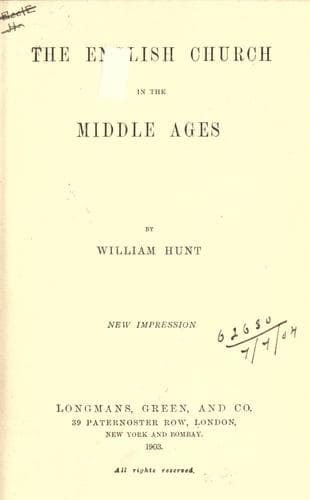
The English Church in the Middle AgesHunt, William
History
The English Church in the Middle Ages
Hunt, William
Church history -- Middle Ages, 600-1500; Great Britain -- Church history
Matters were brought to a crisis by the offer of the crown of Sicily to
Henry for his younger son, Edmund, first made by Innocent IV., and
confirmed by his successor, Alexander IV., in the hope of using the wealth
of England to crush Conrad, and afterwards Manfred, the sons of Frederic
II. Henry greedily swallowed the bait, and incurred an enormous debt to
the Pope for the war in Apulia. By the advice of Peter, the Provencal
bishop of Hereford, he tried to satisfy the Pope by the shameful trick of
attaching the seals of the bishops, without their knowledge, to blank
bonds, to be filled up as the Pope chose. Alexander IV. treated the
English Church as insolently as his predecessor. Soon after the
appointment of an Englishman to the deanery of York in 1256, an Italian
cardinal appeared in the church, and was installed as dean by his
companions; he had been "provided" by the Pope. The archbishop, Sewal de
Bovil, had been a pupil of Edmund of Canterbury, by that time canonized,
and was a friend of the famous Oxford Franciscan, Adam Marsh. He
successfully resisted the intrusion. His courage brought excommunication
on him and an interdict on his church, and he died broken-hearted, after
sending a letter to the Pope bidding him remember that the Lord's charge
to Peter was to "feed His sheep, not shear them or devour them." In 1256,
Alexander's envoy, Rustand, pressed the bishops for a tenth for three
years for the Sicilian scheme. Fulk, bishop of London, declared that he
would sooner lose his head; and Walter of Cantelupe, bishop of Worcester,
that he would sooner be hanged. Henry, as his wont was, abused Fulk, and
threatened that the Pope should deprive him. "Let them take away my mitre,
I shall still keep my helmet," was the bishop's answer. The clergy
remonstrated against the envoy's proposal in their diocesan synods, and,
thanks to the opposition offered by the lay barons, the Pope and the king
were defeated. The reverence which Englishmen formerly had for the Roman
Church had now disappeared, and bitter and contemptuous feelings had taken
its place. The venality of the papal court and the wrongs of the Church
were the favourite themes of the ballad-singer; and English monks loved to
tell of visions which represented Innocent as dying struck by the spear of
the glorified bishop of Lincoln, and of the sentence pronounced against
him by the Eternal Judge on the accusation of the Church he had persecuted
and degraded.
[Sidenote: The Church and the Barons' War.]
Public-domain text, read in full here on John Shaqi.
Reviews
Reviews
No reviews yet
Be the first to share your thoughts on this work.
Elsewhere in the archive
Join the Discussion
Join the discussion
Sign in to leave a comment or review.
Sign InorCreate an account