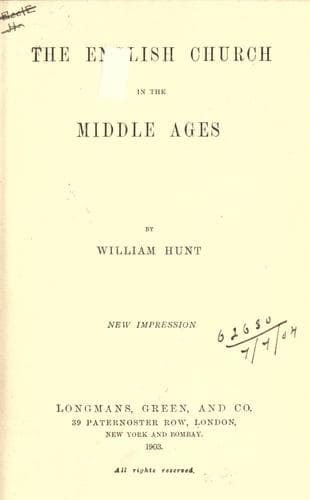
The English Church in the Middle AgesHunt, William
History
The English Church in the Middle Ages
Hunt, William
Church history -- Middle Ages, 600-1500; Great Britain -- Church history
Meanwhile the province of York had been exposed to the ravages of the
Scots. Edward prevailed on John XXII. to command a truce and send over
legates with authority to excommunicate Bruce. The legates' envoys were
robbed and ill-treated, and the sentence was accordingly pronounced. It
had no effect on the war, and in 1318 the Scots broke into Yorkshire. They
made a savage raid, and did much damage to churches and ecclesiastical
property. Ripon paid them L1000 for its safety. A new archbishop, William
Melton, had lately been consecrated. He had served the king and his
father well, and Edward, after some trouble, had obtained the Pope's
confirmation for him. He was made one of the wardens of the marches, and
at once arrayed his tenants for military service. There was little help to
be obtained from the king, and when the Scots came down the next year most
of the fighting men of the north had been called away to Edward's army at
Berwick. Melton, however, raised what local force he could, and led a
large and undisciplined host to meet the Scottish army at Myton. The
archbishop's army was routed, and so many clerks were slain in the battle
that it was called the "chapter of Myton." The absence of any united and
vigorous action for the defence of the country was largely due to the
disloyalty and selfishness of Thomas, earl of Lancaster. The earl was
powerful in Yorkshire, and after making a league for mutual support with
the lords of the north, he summoned a meeting of the estates at Sherburn,
near Pomfret, in 1321. To this northern parliament he called the
archbishop and prelates of the province, and Melton and the clergy obeyed
his summons, evidently with the hope of making peace. Lancaster's
parliament met in the parish church, and after the schedule of grievances
and the lords' bond of association had been read, the earl bade the
prelates consult apart, and give him their answer; for all was done as
though in a legal and national parliament. The clergy debated in the
rectory, and sent a reply in to the earl that was wise and worthy of their
profession. They petitioned for a cessation of hostile movements, and for
concord in the next parliament, so that, by God's favour, parliament might
find remedies for the grievances expressed in the articles. In other
words, they exhorted the earl to abandon his isolated position, and seek
the good of the country by peaceful and constitutional means. Their answer
was received graciously, but their advice was not followed. The archbishop
took no part in the disloyal conduct of the majority of the bishops; he
and his suffragan of Carlisle, and two bishops of the southern province,
protested against the deposition of Edward II., and he abstained from
attending the coronation of the young king.
[Sidenote: Parliament and convocation.]
Public-domain text, read in full here on John Shaqi.
Reviews
Reviews
No reviews yet
Be the first to share your thoughts on this work.
Elsewhere in the archive
Join the Discussion
Join the discussion
Sign in to leave a comment or review.
Sign InorCreate an account