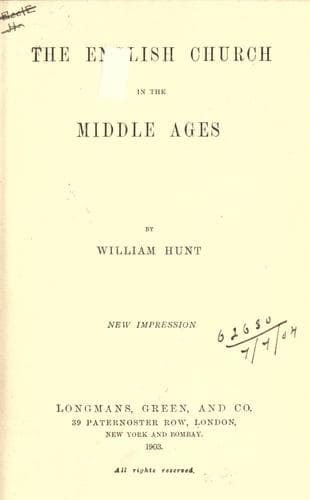
The English Church in the Middle AgesHunt, William
History
The English Church in the Middle Ages
Hunt, William
Church history -- Middle Ages, 600-1500; Great Britain -- Church history
A decisive blow was given to the power of the Popes in England by the
folly of Boniface VIII., who forced Edward I. into hostility, and so made
the Crown at one with the people in resisting papal pretensions. Nor were
the clergy whole-hearted on the Popes' side, for they had learned by
bitter experience that they would at least gain nothing by the victory of
Rome. Almost as soon, then, as the machinery for the expression of the
national will was perfected, the king and the nation used it to express
their indignation at the usurpations of the papacy. The reign is further
memorable in ecclesiastical history for the king's work in defining the
position of the Church in relation to the State. The policy of making the
clergy a parliamentary estate so far failed that they succeeded in
withdrawing themselves from parliament and making their grants in
convocation, yet the attempt to secure their attendance brought their
action in fiscal matters into correspondence with, though not into
dependence upon, the action of the other estates of the realm. In matters
of jurisdiction, Edward's rule contained in the writ "Circumspecte agatis"
was founded on clear and well-considered principles, and became the
groundwork of all future legislation on the subject in mediaeval times. In
all points the Church was given an ascertained place in the national
system, and while the king exacted many heavy taxes from the clergy, and
occasionally, when it suited his convenience, made use of the papal
authority, he never gave way to any attempt of Pope or archbishop to act
as though the clergy had separate interests from the nation at large. For
our purpose, the reign of his unhappy son is important mainly as
exhibiting how entirely the success of the policy of Edward I. was the
result of his personal character. The weakness of Edward II. gave the
Popes a chance of which they did not fail to avail themselves. While
wholly under French influence, they did not hesitate to treat the English
Church as arrogantly as they had treated it in the days when the papacy
was strong. Under Edward I. the chapters virtually lost the power of
electing bishops; during the reign of his son the will of the Crown was
constantly set at nought, and the introduction of the system of
reservation and provision as applied to bishoprics indicates the utter
disregard with which the rights both of the Church and the king were
treated at Avignon.
[Sidenote: 1343-1377.]
Public-domain text, read in full here on John Shaqi.
Reviews
Reviews
No reviews yet
Be the first to share your thoughts on this work.
Elsewhere in the archive
Join the Discussion
Join the discussion
Sign in to leave a comment or review.
Sign InorCreate an account