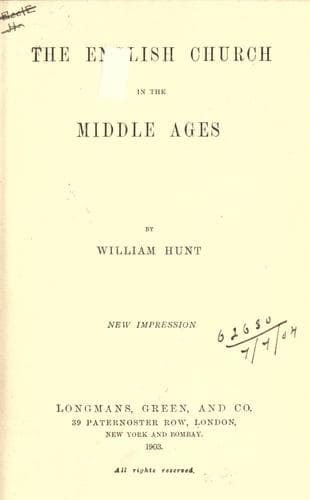
The English Church in the Middle AgesHunt, William
History
The English Church in the Middle Ages
Hunt, William
Church history -- Middle Ages, 600-1500; Great Britain -- Church history
With the exception of Worcester, no English see was left in the hands of a
native bishop. They were held either by Normans or by the Lotharingians
who had been appointed in the Confessor's reign. At Worcester, Wulfstan,
though not a man of learning, was allowed to retain his bishopric on
account of his holiness. Among his other good works, he preached in
Bristol against the slave-trade with Ireland that was largely carried on
there, and persuaded the townsmen to give it up. Most of William's bishops
were men of high character, for his appointments were free from simony,
and were, no doubt, suggested by Lanfranc; and the king himself had no
liking for evil men. Some of them were learned; nearly all were
magnificent. They did not play a great part in State affairs, and stand in
some contrast both to the old native bishops, who were leaders of the
witan, and, though several of them had been the king's clerks, to the
bishops of a later period, who were before all things royal ministers.
They generally rebuilt their churches in the Norman style, of which the
Confessor's church at Westminster was the earliest example in England. At
York, Archbishop Thomas did away with the discipline introduced by
Ealdred, and assigned separate prebends to each of the canons, an
arrangement which was gradually adopted in all cathedral churches with
secular chapters. That the chapter of a cathedral church should consist of
monks was extremely rare except in England, but as the Normans generally
were strong supporters of monasticism, this was a peculiarity of which
they approved, and in some churches secular canons were displaced by
monks. Some of the bishops, however, who were not monks, with Walchelin,
bishop of Winchester, at their head, saw that monastic chapters were a
hindrance to the bishop, and were unfitted for their duties. They
conceived the idea of replacing the monks by secular canons even in the
metropolitan church. William is said to have approved of the scheme; but
it was highly distasteful to Lanfranc, "the father of the monks," and he
obtained a letter from Alexander II. indignantly forbidding it. The scheme
was defeated, and Walchelin, who had forty clerks with their tonsure cut
and their dress prepared as canons, ready to take the place of the monks
of St. Swithun's, and to divide the monastic estates into prebends, had to
send them about their business. Although William's Norman bishops were
generally good specimens of continental churchmen, they had no sympathy
with the thoughts and feelings of their clergy and people. Of one only,
Osbern of Exeter, it is said that he adopted the English mode of life.
Lanfranc despised the national saints, and doubted the right of his
predecessor, AElfheah, to the title of martyr, until he was taught better
by Anselm, abbot of Bec. The admiration of the Normans for monasticism
caused a considerable increase in the practice of endowing monasteries
Public-domain text, read in full here on John Shaqi.
Reviews
Reviews
No reviews yet
Be the first to share your thoughts on this work.
Elsewhere in the archive
Join the Discussion
Join the discussion
Sign in to leave a comment or review.
Sign InorCreate an account