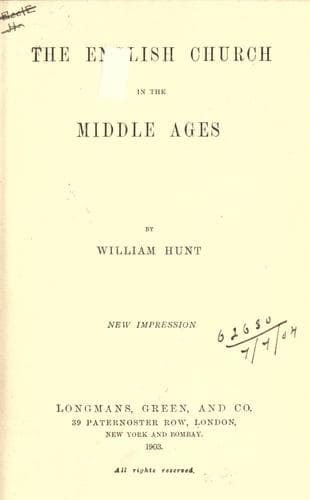
The English Church in the Middle AgesHunt, William
History
The English Church in the Middle Ages
Hunt, William
Church history -- Middle Ages, 600-1500; Great Britain -- Church history
Henry, like his father, aimed at establishing perfect harmony between
Church and State, keeping both alike in absolute dependence upon himself.
Accordingly he resisted any unauthorized interference on the part of the
Pope with the affairs of the Church. Early in the reign a Burgundian
archbishop landed here without invitation, claiming legatine authority
over the whole kingdom. His claim was pronounced "unheard of." Although
the Conqueror had invited the Pope to send him legates for a specified
purpose, the archbishop of Canterbury was held to be the permanent
representative of the Holy See in England, a _legatus natus_, whose
authority was not to be superseded by a special legate, or _legatus a
latere_. No one acknowledged the legate's authority, and "he went back,"
Eadmer remarks, "as he came." A more serious attempt to override the
rights of the Church was made in the time of Anselm's successor, Ralph.
The king was in Normandy, and when it became known that a legate, Anselm's
nephew and namesake, was on his way hither, the bishops and nobles of the
kingdom met in council, and sent Ralph over to Henry to request that he
"would bring the innovation to nought," and the king prevented the legate
Anselm from landing. In the time of the next archbishop, William of
Corbeuil, Henry was, for political reasons, anxious to stand well with
Rome, and accordingly admitted into the kingdom a legate from Honorius
II., named John of Crema. Men saw with indignation that this legate sat in
the highest seat in the metropolitan church, and said mass in the
archbishop's stead, clad in episcopal vestments, though he was only a
priest; "for both England and other countries knew that, from St. Augustin
onwards, the archbishops were held to be primates and patriarchs, and were
never made subject to a Roman legate." At the same time, though John
occupied the seat of honour at the council of 1125, the summons ran in
the name of the archbishop and the decrees were confirmed by the king.
While, then, the Crown, the English Church, and the papal representative
acted concurrently, the royal authority was saved. It was not so with the
see of Canterbury or with the national interests it represented, and the
archbishop went to Rome to complain of the injury done to his see.
Honorius silenced his complaints by giving him a legatine commission, a
measure which, while gratifying William personally, lessened the inherent
dignity of his see and the independence of the Church.
[Sidenote: Thurstan, archbishop of York, 1119-1140.]
Public-domain text, read in full here on John Shaqi.
Reviews
Reviews
No reviews yet
Be the first to share your thoughts on this work.
Elsewhere in the archive
Join the Discussion
Join the discussion
Sign in to leave a comment or review.
Sign InorCreate an account