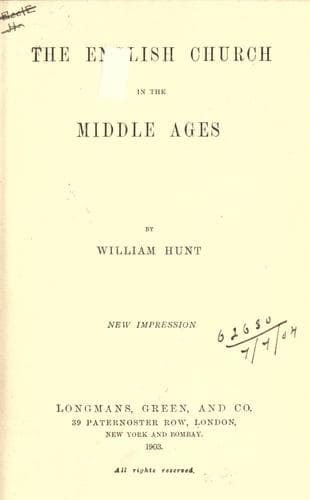
The English Church in the Middle AgesHunt, William
History
The English Church in the Middle Ages
Hunt, William
Church history -- Middle Ages, 600-1500; Great Britain -- Church history
For a while the Church remained faithful to Stephen. The
statesmen-bishops, Roger, the justiciar, and his nephews, the bishop of
Ely, the treasurer, and the bishop of Lincoln, together with Bishop
Roger's son, also called Roger, the chancellor, continued to carry on the
administration. In the north a Scottish invasion was checked by the energy
of the aged Archbishop Thurstan, who from his sick-bed stirred the
Yorkshire men to meet the invaders. He was represented in the camp by his
suffragan, the bishop of the Orkneys. The standard of the English army
bore aloft the Host, and the figures of the patron saints of the three
great Yorkshire churches, and the "Battle of the Standard," in which the
Yorkshire men were completely victorious, had something of the character
of a Holy War, in which the archbishop acted, as of old, as the natural
head of the northern people.
[Sidenote: Stephen's quarrel with the Church.]
The mischievous results of the appointment of Archbishop William as legate
were apparent at his death; for Innocent granted a legatine commission,
not to his successor, Theobald, but to Henry of Winchester. The authority
of the see of Canterbury was thus grievously diminished, and the
archbishop was made second to a resident representative of the Pope, one
of his own suffragans. The abasement of Canterbury naturally drew the
Church into greater dependence on Rome, and appeals, which had hitherto
been almost unknown, became of constant occurrence. Equally unlike the
justiciar, Roger of Salisbury, who devoted himself to secular
administration and ambitions, and the churchmen who, full of the new
fervour of the Cistercian movement, sought to raise the spiritual dignity
of the Church, Henry of Winchester used his vast powers to exalt her
temporal greatness. His jealousy for the privileges of the clergy brought
him into collision with the king, who now by an act of extreme folly
provoked a quarrel with the clerical order. Stephen suspected the loyalty
of the bishop of Salisbury and his house, and caused him and the bishop of
Lincoln to be arrested at Oxford. They were powerful lords and had reared
several mighty castles. These they were forced to surrender by threats and
ill-treatment. Stephen acted with the violence of a weak man; he had
already lost the obedience of the barons, and the people must have learnt
that his promises were not to be relied on; now he ensured his fall by
offending the clergy. The legate summoned him to appear before a synod at
Winchester, and the king of England actually appeared by his counsellor,
Alberic de Vere, who made his defence. When he refused to restore the
bishops' castles there was some talk of laying the case before the Pope.
This he forbade, and yet appealed to Rome himself. At last he appeared
before the legate stripped of his royal robes, and humbly received his
censure "for having stretched out his hand against the Lord's anointed
ones." Nevertheless the Church was alienated from him, and after his
Public-domain text, read in full here on John Shaqi.
Reviews
Reviews
No reviews yet
Be the first to share your thoughts on this work.
Elsewhere in the archive
Join the Discussion
Join the discussion
Sign in to leave a comment or review.
Sign InorCreate an account