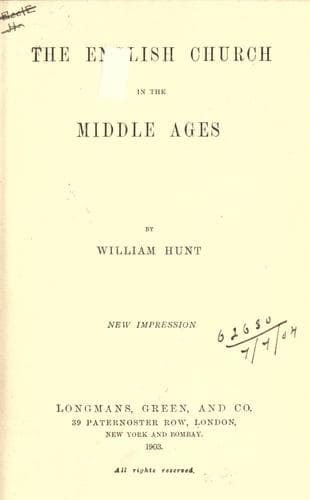
The English Church in the Middle AgesHunt, William
History
The English Church in the Middle Ages
Hunt, William
Church history -- Middle Ages, 600-1500; Great Britain -- Church history
archbishop was an easy-going man, and did not please Becket's party.
Neither he nor the bishops caused the king any trouble during the
remainder of his reign.
[Sidenote: His general relations to the Church.]
Although the Constitutions of Clarendon were nominally abandoned, they had
considerable effect on the future relations between Church and State, and
indeed determined their development. Even in Henry's reign the privileges
which Archbishop Thomas had claimed for the Church were slightly
curtailed. With the papal sanction, clerks were made amenable to the
forest laws; for what business had they to hunt? And the murderers of
clerks were given up to the civil courts; for the claim of the Church to
punish them was reduced to an absurdity when it sheltered Becket's
murderers from justice, and they were simply punished by such penalties as
the Pope, the supreme spiritual judge, could inflict. As Henry caused the
lands of the Church, which had hitherto escaped taxation, to bear their
share of scutage, so when, for the first time, he introduced a tax on
movables the clergy were taxed equally with the laity. This tax, called
the Saladine tenth, was granted the king by a great council, and the
property both of clerks and laymen was assessed by a jury.
[Sidenote: Legates.]
After Becket's death Henry took care to keep on good terms with Rome. At
his request a legate named Hugh visited this country, partly, at least, to
settle a new dispute between Canterbury and York, and from him the king
obtained leave to bring the clergy under the forest laws. So far had the
martyrdom of St. Thomas injured the independence of the kingdom that even
a matter of domestic law was submitted to the papal judgment. Hugh's
mission was not successful. At a council held at Westminster in 1176,
Roger of York tried to squeeze himself into a more honourable seat than
the archbishop of Canterbury. This led to a disturbance in which sticks
and fists were freely used. Hugh ran about the chapel in terror, and
finding "that he had no authority in England," soon went his way. A few
months later Henry showed that, in spite of his late humiliation, he was
not prepared to be the Pope's humble servant; for when another legate
landed on his way to Scotland, he sent two bishops, who asked him "by
whose authority he dared to enter his kingdom without his leave," and
exacted a promise from him that he would do nothing here without his will.
[Sidenote: Heresy.]
Public-domain text, read in full here on John Shaqi.
Reviews
Reviews
No reviews yet
Be the first to share your thoughts on this work.
Elsewhere in the archive
Join the Discussion
Join the discussion
Sign in to leave a comment or review.
Sign InorCreate an account