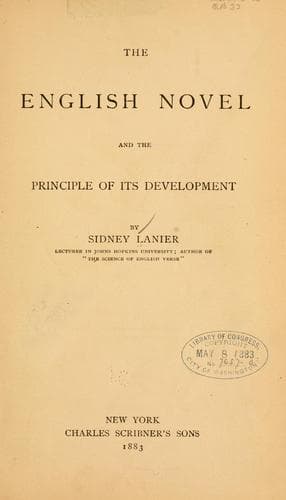
The English Novel and the Principle of its DevelopmentLanier, Sidney
History
The English Novel and the Principle of its Development
Lanier, Sidney
English fiction -- History and criticism
Remembering how we have agreed that the author's comments in the
modern novel, acquainting us with such parts of the action as could
not be naturally or conveniently brought upon the stage, might be
profitably regarded as a development of certain well-known functions
of the chorus in the Greek drama--we have here a quite palpable
instance of the necessity for such development; how otherwise, could
we be let into the inner emotions of farm-horses so genially as in
this charming passage?
In Chapter II. we are introduced to Mr. and Mrs. Tulliver talking by
the fire in the left-hand corner of their cosy English home, and I
must read a page or two of their conversation before bringing Maggie
on the stage, if only to show the intense individuality of the latter
by making the reader wonder how such an individualism could ever have
been evolved from any such precedent conditions as those of Mr. and
Mrs Tulliver. "What I want, you know," said Mr. Tulliver,--
"What I want is to give Tom a good eddication--an eddication
as'll be bread to him. That was what I was thinking of when I
gave notice for him to leave th' academy at Ladyday. I mean to
put him to a downright good school at Midsummer. The two years at
th' academy 'ud ha' done well enough, if I'd meant to make a
miller and farmer of him, for he's had a fine sight more
schoolin' nor _I_ ever got: all the learnin' _my_ father ever
paid for was a bit o' birch at one end and the alphabet at th'
other. But I should like Tom to be a bit of a schollard, so as he
might be up to the tricks o' these fellows a stalk fine and write
with a flourish. It 'ud be a help to me wi' these lawsuits, and
arbitrations, and things. I wouldn't make a downright lawyer o'
the lad--I should be sorry for him to be a raskell--but a sort o'
engineer, or a surveyor, or an auctioneer and vallyer, like
Riley, or one o' them smartish businesses as are all profits and
no out-lay, only for a big watch-chain, and a high stool. They're
putty nigh all one, and they're not far off being even wi' the
law, _I_ believe; for Riley looks Lawyer Wakem i' the face as
hard as one cat looks another. _He's_ none frightened at him."
Mr. Tulliver was speaking to his wife, a blonde comely woman, in
a fan-shaped cap (I am afraid to think how long it was since
fan-shaped caps were worn--they must be so near coming in again.
At that time, when Mrs. Tulliver was nearly forty, they were new
at St. Ogg's, and considered sweet things).
"Well, Mr. Tulliver, you know best; _I've_ no objections. But
hadn't I better kill a couple o' fowl and have th' aunts and
uncles to dinner next week, so as you may hear what sister Glegg
and sister Pullet have got to say about it? There's a couple o'
fowl _wants_ killing!"
Public-domain text, read in full here on John Shaqi.
Reviews
Reviews
No reviews yet
Be the first to share your thoughts on this work.
Elsewhere in the archive
Join the Discussion
Join the discussion
Sign in to leave a comment or review.
Sign InorCreate an account