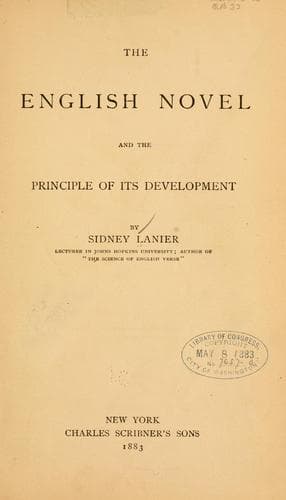
The English Novel and the Principle of its DevelopmentLanier, Sidney
History
The English Novel and the Principle of its Development
Lanier, Sidney
English fiction -- History and criticism
Before this remonstrance was finished Maggie was already out of
hearing, making her way toward the great attic that ran under
the old high-pitched roof, shaking the water from her black
locks as she ran, like a Skye terrier escaped from his bath. This
attic was Maggie's favorite retreat on a wet day, when the
weather was not too cold; here she fretted out all her
ill-humors, and talked aloud to the worm-eaten floors and the
worm eaten shelves, and the dark rafters festooned with cobwebs;
and here she kept a Fetish which she punished for all her
misfortunes. This was the trunk of a large wooden doll, which
once stared with the roundest of eyes above the reddest of
cheeks, but was now entirely defaced by a long career of
vicarious suffering. Three nails driven into the head
commemorated as many crises in Maggie's nine years of earthly
struggle, that luxury of vengeance having been suggested to her
by the picture of Jael destroying Sisera in the old Bible. The
last nail had been driven in with a fiercer stroke than usual,
for the Fetish on that occasion represented aunt Glegg."
But a ray of sunshine on the window of the garret proves too much for
her; she dances down stairs, and after a wild whirl in the sunshine
with Yap the terrier goes up into the mill for a talk with Luke the
miller.
"Maggie loved to linger in the great spaces of the mill, and
often came out with her black hair powdered to a soft whiteness
that made her dark eyes flash out with a new fire. The resolute
din, the unresting motion of the great stones, giving her a dim
delicious awe as at the presence of an uncontrollable force--the
meal forever pouring, pouring--the fine white powder softening
all surfaces, and making the very spider-nets look like a fancy
lace-work--the sweet, pure scent of the meal--all helped to make
Maggie feel that the mill was a little world apart from her
outside, everyday life. The spiders were especially a subject of
speculation with her. She wondered if they had any relations
outside the mill, for in that case there must be a painful
difficulty in their family intercourse--a flat and floury spider,
accustomed to take his fly well dusted with meal, must suffer a
little at a cousin's table where the fly was _au naturel_; and
the lady-spiders must be mutually shocked at each other's
appearance. But the part of the mill she liked best was the
topmost story--the corn-hutch, where there were the great heaps
of grain, which she could sit on and slide down continually. She
was in the habit of taking this recreation as she conversed with
Luke, to whom she was very communicative, wishing him to think
well of her understanding, as her father did. Perhaps she felt it
necessary to recover her position with him on the present
Public-domain text, read in full here on John Shaqi.
Reviews
Reviews
No reviews yet
Be the first to share your thoughts on this work.
Elsewhere in the archive
Join the Discussion
Join the discussion
Sign in to leave a comment or review.
Sign InorCreate an account