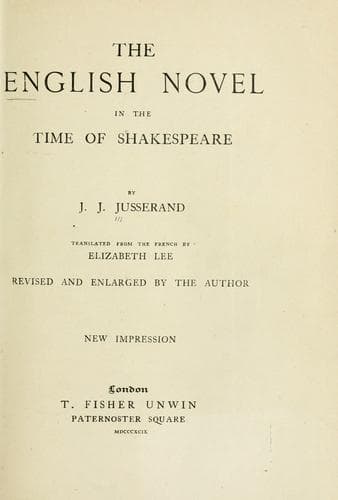
The English Novel in the Time of ShakespeareJusserand, J. J. (Jean Jules)
History
The English Novel in the Time of Shakespeare
Jusserand, J. J. (Jean Jules)
English fiction -- Early modern, 1500-1700 -- History and criticism
There are also in Breton imitations of the romantic novel of Italian
origin such as Greene understood it and such as the Elizabethan public
loved it. Breton published in 1600 his "Strange fortunes of two
excellent princes," which his modern editor does not hesitate to declare
"a bright and characteristic little book." This little masterpiece
begins thus, in very characteristic fashion indeed: "In the Ilandes of
Balino, neere unto the city of Dulno, there lived a great duke named
Firente.... This lord had to wife a sweete ladie called Merilla, a
creature of much worth.... This blessed lord and ladie had issue male,
onlie one sonne named Penillo and female one onlie daughter named
Merilla." These two children were famous for their wit and beauty. "But
I will ... entreat of another Duke, who dwelt in the Ilands of
Cotasie.... This duke had to name Ordillo, a man famous for much worth
as well in wit as valour.... This duke had to wife a gratious ladie....
She had by her lord the duke two blessed children, a sonne and a
daughter; her sonne named Fantiro and her daughter Sinilla." These two
children begat wonder for their wit and their beauty.
Such is the introduction. What do you think will follow? That the two
perfect young men will marry the two unique young women? This is exactly
what happens; and the only perceptible interest in the tale is to see
from what improbable incidents such likely consequences are derived. We
can safely, it seems, class this novel in the same category as
"Arbasto," "Mamillia," and other products of Greene's pen; not, however,
without remarking that Breton's stories, as well as those of his model,
were not meant to delight nurseries, but were destined to give pleasure
to grown-up people, to people in society; they were offered them as
_jucunda oblivia vitae_, exactly in the same fashion as the three-volume
novels of to-day. Breton himself is positive on this point, and he has
been careful to inform us that his intention was to write things "which
being read or heard in a winters evening by a good fire, or a summers
morning in the greene fields may serve both to purge melancholy from
the minde and grosse humours from the body."[153]
Public-domain text, read in full here on John Shaqi.
Reviews
Reviews
No reviews yet
Be the first to share your thoughts on this work.
Elsewhere in the archive
Join the Discussion
Join the discussion
Sign in to leave a comment or review.
Sign InorCreate an account