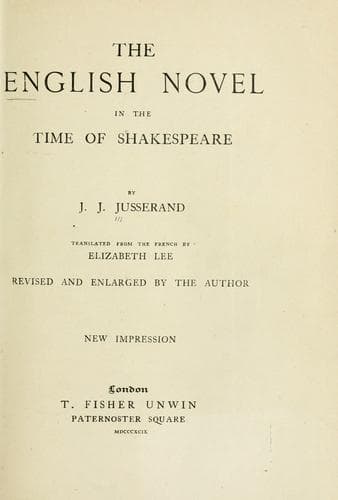
The English Novel in the Time of ShakespeareJusserand, J. J. (Jean Jules)
History
The English Novel in the Time of Shakespeare
Jusserand, J. J. (Jean Jules)
English fiction -- Early modern, 1500-1700 -- History and criticism
[139] "Histoire tragique de Pandosto roy de Boheme et de Bellaria sa
femme. Ensemble les amours de Dorastus et de Faunia; ou sont comprises
les adventures de Pandosto roy de Boheme, enrichies de feintes
moralites, allegories, et telles autres diversites convenables au sujet.
Le tout traduit premierement en Anglois de la langue Boheme et de
nouveau mis en francois par L. Regnault," Paris, 1615, 12mo. A copy in
the Bodleian Library.
[140] "Histoire tragique de Pandolphe roy de Boheme et de Cellaria sa
femme, ensemble les amours de Doraste et de Faunia; enrichie de figures
en taille douce," Paris, 1722, 12mo.
[141] "Menaphon. Camillas alarum to slumbering Euphues, in his
melancholie cell at Silexedra," 1589. "Works," vol. vi.
[142] "The blacke bookes messenger, laying open the life and death of
Ned Browne one of the most notable of cutpurses ... in England. Heerein
hee telleth verie pleasantly in his owne person such strange prancks ...
as the like was yet never heard of," 1592, "Works," vol. xi.
[143] "Groats-worth of wit," "Works," vol. xii. p. 140.
[144] "Greenes never too late," "Works," vol. viii. p. 67.
[145] "A quip for an upstart courtier, or a quaint dispute between
velvet breeches and cloth breeches," London, 1592; "Works," vol. xi. In
the year of its publication it went through three editions and had
several afterwards. It was translated into Dutch: "Een seer vermakelick
Proces tusschen Fluweele-Broeck ende Laken-Broek," Leyden, 1601, 4to.
Greene had as his model in writing this book F. T.'s "Debate between
pride and lowliness," and he drew much from it, though not so much by
far as he has been accused of by Mr. Collier. "The Debate," &c.,
Shakespeare Society, 1841, preface. (F. T. is not Francis Thynne.)
[146] Dedication of "Parismus," 1598.
[147] The thirteenth edition of "Parismus" appeared in 1649; there were
others in 1657, 1663, 1664, 1665, 1668, 1671, 1677, 1684, 1690, 1696,
1704, &c. (Sidney L. Lee.)
[148] London, 1598, 4to.
[149] Sig. C iii. _et seq._
[150] Act i. sc. 4. "Romeo" was first printed in 1597. A contemporary
representation of such an _entree_ of maskers is to be seen in the
curious painting representing Sir H. Unton and the principal events in
his life; now kept in the National Portrait Gallery (painted about
1596).
[151] "Parismenos, the second part of ... Parismus," 1599; "Ornatus and
Artesia," of uncertain date, but surely anterior to 1598; "Montelion,
Knight of the Oracle," of uncertain date; the earliest known copy bears
date, 1633. Francis Meres, in his celebrated "Palladis Tamia," gives a
list of books "hurtful to youth," and which are to be "censured"; among
them, besides "Gargantua," "Owlglass," &c., he names "Ornatus and
Artesia" and the "Black Knight," which might perhaps be "Parismus," for
such was our hero's nickname.
[152] "Works in verse and prose," ed. Grosart, London, 1879, 2 vols.,
4to. Breton was born in 1542-3; he studied at Oxford, and travelled on
the continent; he died in 1626.
Public-domain text, read in full here on John Shaqi.
Reviews
Reviews
No reviews yet
Be the first to share your thoughts on this work.
Elsewhere in the archive
Join the Discussion
Join the discussion
Sign in to leave a comment or review.
Sign InorCreate an account