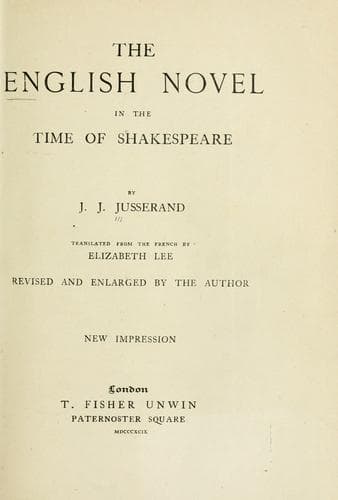
The English Novel in the Time of ShakespeareJusserand, J. J. (Jean Jules)
History
The English Novel in the Time of Shakespeare
Jusserand, J. J. (Jean Jules)
English fiction -- Early modern, 1500-1700 -- History and criticism
In spite of his fondness for the ancients, whose unities and messenger
he greatly approves, and of his contempt for the modern drama, such as
it was understood in those pre-Shakespearean times, he remains, at
bottom, entirely English; he adores the old memorials of his native
land, and does not know his Virgil better than his Chaucer, or even the
popular songs hummed by the wayfarer along the high roads. Irish
ballads, English ballads of Robin Hood, Scottish ballads of Douglas, are
familiar to him, and some of them make him start as at the sound of a
trumpet: "Certainly, I must confesse my own barbarousnes, I never heard
the olde song of Percy and Douglas, that I found not my heart mooved
more then with a trumpet: and yet it is sung by some blind crouder, with
no rougher voyce then rude stile; which being so evill apparelled in the
dust and cobwebbes of that uncivill age, what would it worke, trymmed in
the gorgeous eloquence of Pindar?" He would have loved, like Moliere,
the song of the "roi Henri," and like La Fontaine, the story of Peau
d'Ane. But his closest sympathies were reserved for poetical tales, for
the adventures of Roland and King Arthur, which are a soldier's reading,
and even for the exploits of Amadis of Gaul. "I dare undertake 'Orlando
furioso' or honest King Arthur will never displease a souldier....
Truely, I have knowen men, that even with reading 'Amadis de Gaule,'
which God knoweth wanteth much of a perfect poesie, have found their
hearts mooved to the exercise of courtesie, liberalitie and especially
courage." He imagines nothing more enchanting or more powerful than the
charm of poetical prose stories, "any of which holdeth children from
play, and old men from the chimney corner." Their attraction has
something superior, divine; for, he adds with a depth of emotion that
appears quite modern, "so is it in men, most of which are childish in
the best things, till they bee cradlid in their graves."[187]
He closes with a witty and delightful ending, a kindly wish for the
hardened enemies of poetry: "Yet this much curse I must send you, in the
behalfe of all Poets, that while you live, you live in love, and never
get favour, for lacking skill of a sonnet: and when you die, your memory
die from the earth, for want of an epitaph."
Neither did Sidney lack epitaphs; all the poets wept for him; nor was he
wanting in those favours that a sonnet can win, for he wrote the most
passionate that appeared in England before those of Shakespeare. Like
the "Apologie" they move us by their youth and sincerity; they come from
the heart:
"Loving in truth, and faine in verse my love to show,
That She, dear She! might take some pleasure of my paine:
* * * * *
Public-domain text, read in full here on John Shaqi.
Reviews
Reviews
No reviews yet
Be the first to share your thoughts on this work.
Elsewhere in the archive
Join the Discussion
Join the discussion
Sign in to leave a comment or review.
Sign InorCreate an account