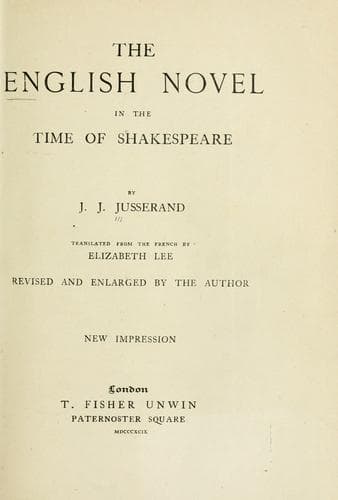
The English Novel in the Time of ShakespeareJusserand, J. J. (Jean Jules)
History
The English Novel in the Time of Shakespeare
Jusserand, J. J. (Jean Jules)
English fiction -- Early modern, 1500-1700 -- History and criticism
Sidney, according to his friend Fulke Greville, Lord Brooke, had the
highest moral and political purposes, in writing his "Arcadia": "In all
these creatures of his making, his interest and scope was, to turn the
barren philosophy precepts into pregnant images of life; and in them,
first on the monarchs part, lively to represent the growth, state and
declination of princes, changes of government and lawes ... Then again
in the subjects case, the state of favour, disfavour, prosperitie,
adversity ... and all other moodes of private fortunes or misfortunes,
in which traverses, I know, his purpose was to limn out such exact
pictures of every posture in the minde, that any man might see how to
set a good countenance upon all the discountenances of adversitie."[201]
When Greville wrote thus, Sidney was dead, and in his retrospect of his
friend's life he was with perfect good faith discovering high, not to
say holy motives, for all his actions. Sidney's own explanation suits
his work better; he was delivering his "young head" of "many, many
fancies," and their main object was not politics, but love. He described
it as it was known and practised in his time. Most of the heroes in the
"Arcadia," talk like Surrey, Wyatt, Watson, and all the "amourists" of
the century, like Sidney himself when he addressed another than Stella.
The modesty of their characters is equal to their tenderness; valiant as
lions before the enemy, they tremble like the leaf before their
mistresses; they feed on smiles and tender glances; when they have to
suffer a scarcity of this heavenly food they can only die: "Hee dieth:
it is most true, hee dieth; and he in whom you live dieth. Whereof if
though hee plaine, hee doth not complaine: for it is a harme but no
wrong which hee hath received. He dies, because in wofull language all
his senses tell him, that such is your pleasure." Fair Pamela feels
deeply moved when reading this, and confesses her harshness; she denied
him a look: "Two times I must confess," says she to her sister, not
without a pretty touch of humour of a very modern sort, "I was about to
take curtesie into mine eyes, but both times the former resolution stopt
the entrie of it: so, that hee departed without obtaining any further
kindenesse. But he was no sooner out of the doore, but that I looked to
the doore kindly!" The poor lover who did not see this change in his
lady's countenance went away fainting, "as if he had beene but the
coffin that carried himselfe to his sepulchre!"[202]
Public-domain text, read in full here on John Shaqi.
Reviews
Reviews
No reviews yet
Be the first to share your thoughts on this work.
Elsewhere in the archive
Join the Discussion
Join the discussion
Sign in to leave a comment or review.
Sign InorCreate an account