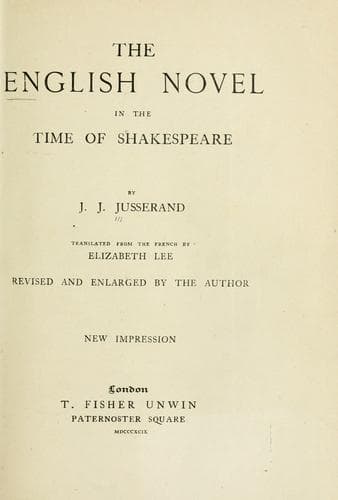
The English Novel in the Time of ShakespeareJusserand, J. J. (Jean Jules)
History
The English Novel in the Time of Shakespeare
Jusserand, J. J. (Jean Jules)
English fiction -- Early modern, 1500-1700 -- History and criticism
The demand for Sidney's book continued long unabated. It was often
reprinted during the seventeenth century,[218] and found imitators,
abbreviators and continuators. Among its early admirers it had that
indefatigable reader of novels, William Shakespeare, who took from it
several hints, especially from the story of the "Paphlagonian unkind
king," which he made use of in his "King Lear."[219] Books were
published under cover of Sidney's name, as "Sir Philip Sydney's
Ourania";[220] others were given away bearing as an epigraph an
adaptation of two well-known verses:
"Nec divinam _Sydneida_ tenta
Sed longe sequere et vestigia semper adora,"[221]
no insignificant compliment, considering the word which had to make
room for "Sydneida." Works without number were dedicated to the Countess
of Pembroke, not only because she was what she was, and a poetess of
some renown, but because she was the Mary Sidney of Arcadian fame.
As Sidney had stated that he did not consider his novel finished with
the marriage of his heroes, and the reconciliation of his royal couple,
continuations were not wanting; writers who did not consider their pen
"dulled" as he had declared his own to be, volunteered to add a further
batch of adventures to the "Sidneyd." Thus we have the "English Arcadia
alluding his beginning to Sir Philip Sidnes ending," by Gervase Markham,
1607; a "Sixth booke to the Countesse of Pembrokes Arcadia, written by
R[ichard] B[eling] of Lincolnes Inne," 1624; or again a "Continuation of
Sir Philip Sydney's Arcadia: wherein is handled the loves of Amphialus
and Helena ... written by a young gentlewoman, Mrs. A. W.," 1651. Dramas
were built upon incidents in the "Arcadia"; Shakespeare we have seen
made use of it in his "King Lear"; John Day wrote after Sidney's tale,
"The Ile of Guls," 1606, "the argument being a little string or rivolet
drawne from the full streme of the right worthy gentleman, Sir Phillip
Sydneys well knowne Archadea."[222] Some years later, in 1640, Shirley
put Basilius and his court again on the stage in his "Pastorall called
the Arcadia."[223]
Public-domain text, read in full here on John Shaqi.
Reviews
Reviews
No reviews yet
Be the first to share your thoughts on this work.
Elsewhere in the archive
Join the Discussion
Join the discussion
Sign in to leave a comment or review.
Sign InorCreate an account