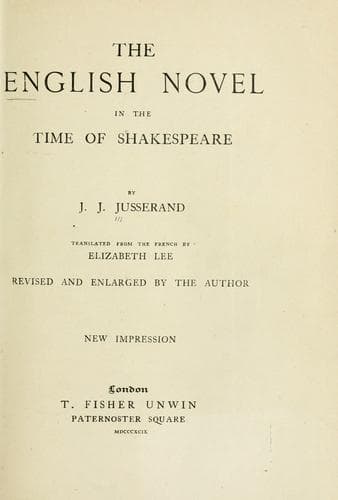
The English Novel in the Time of ShakespeareJusserand, J. J. (Jean Jules)
History
The English Novel in the Time of Shakespeare
Jusserand, J. J. (Jean Jules)
English fiction -- Early modern, 1500-1700 -- History and criticism
As to the story, it is, like the "Arcadia," a tale of shepherds who are
princes, and of shepherdesses with royal blood in their veins; there are
eclogues, dialogues, and if not much poetry at least much verse. The
events take place in Greece and in the Greek islands; people go to the
temple of Diana and to the temple of Venus. In the last-named place they
get married. These worshippers of the deities of old are dressed as
follows. Here is the description of a man's costume: "Then changed he
his armour taking one of azure colour, his plume crimson, and one fall
of blew in it; the furniture to his horse being of those colours, and
his device onely a cipher, which was made of all the letters of his
misstrisses name, delicately composed within the compasse of one." Here
is now a description of the costume women wore in Lady Mary's Greek
land: "She was partly in greene too; as her upper garment, white buskins
she had, the short sleeves which she wore upon her armes and came in
sight from her shoulders were also white, and of a glistering stuffe, a
little ruffe she had about her neck, from which came stripps which were
fastned to the edges of her gowne, cut downe equally for length and
breadth to make it square; the strips were of lace, so as the skinne
came steallinglie through, as if desirous but afraide to bee seane,
knowing that little joy would moove desire to have more." This clever
young person had been "sworn a nymph," which prevented her getting
married for some years. Waiting for that auspicious date a lover was
offering his addresses to her, and as Lady Wroth's Arcadia is an Arcadia
with a peerage, we are informed that this sworn nymph's lover was "the
third sonne of an earle."[227]
No less a man than Ben Jonson proclaimed himself an admirer of Lady
Mary; he dedicated one of his masterpieces, "the Alchemist," to "the
lady most deserving her name and blood, Lady Mary Wroth," and in his
"Epigrams" he addressed her as follows, his only but sufficient excuse
being that the "Urania" was not yet written:
"Madam, had all antiquity been lost,
All history seal'd up and fables crost,
That we had left us, nor by time nor place,
Least mention of a Nymph, a Muse, a Grace,
But even their names were to be made anew
Who could not create them all from you?"[228]
Public-domain text, read in full here on John Shaqi.
Reviews
Reviews
No reviews yet
Be the first to share your thoughts on this work.
Elsewhere in the archive
Join the Discussion
Join the discussion
Sign in to leave a comment or review.
Sign InorCreate an account