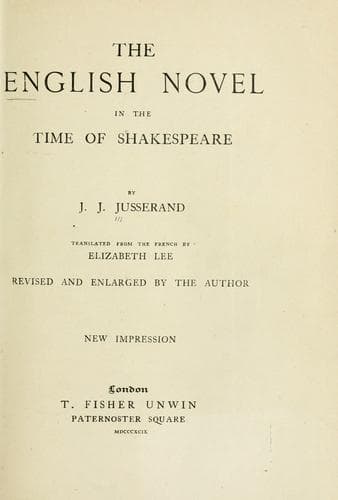
The English Novel in the Time of ShakespeareJusserand, J. J. (Jean Jules)
History
The English Novel in the Time of Shakespeare
Jusserand, J. J. (Jean Jules)
English fiction -- Early modern, 1500-1700 -- History and criticism
Besides this, Sidney's romance received in France an homage very rare
at that epoch: it was translated. A Frenchman possessing a knowledge of
the English language was then an extraordinary phenomenon. As late as
the year 1665, no less a paper than the "Journal des Scavans" printed a
statement to the following effect: "The Royal Society of London
publishes constantly a number of excellent works But whereas most of
them are written in the English language, we have been unable till now
to review them in our pages. But we have at last found an English
interpreter through whose offices it will be henceforth possible for us
to enrich our publication with the best things appearing in England." As
for Sidney, not only was he translated, but what is not less strange,
the fact provoked in France one of the most violent literary quarrels of
the time. Two translations of the "Arcadia," now entirely forgotten,
were published simultaneously, both in three volumes, both adorned with
engravings.[238] As soon as a volume appeared, each of the translators
profited by the occasion to write a new preface, and to repeat that his
rival was a mere plagiarist and did not know a word of English. The
other replied offering to prove such a rare knowledge; had it been a
question of Chinese or of Hindustani they could not have boasted more
noisily of their unique acquaintance with so mysterious an idiom. Each
appealed to his patroness, who was, in either case, no ordinary woman:
the one had dedicated his work to Diane de Chateaumorand (D'Urfe's
Diane), who had indeed the right to judge of Arcadias; the other invoked
the authority of the Queen-mother, Marie de Medicis, by whose express
command he had carried on his work.
Baudoin, who had been the first to turn the "Arcadia" into French,
published it in 1624, prefixing to it this remark, flattering to
Sidney's memory, but which shows how very little his language was known
in France: "Merely the desire of understanding so rare a book caused me
to go to England, where I remained for two years in order to gain a
knowledge of it."
[Illustration: "THE GLORIOUS ENTERTAINMENTS THAT GRACED THE HAPPY
NUPTIALS."]
Two years! immediately retorts the publisher of the other translation;
we can do better than that: the author of the work that we publish is
Mademoiselle Genevieve Chappelain, and what guarantees does she not
offer! "She has the honour to have lived more than seven years at the
court of the King of Great Britain, in the suite of the Countess of
Salisbury, who esteemed her as no ordinary young girl, but as a very
well-bred demoiselle who had been presented to her with good
credentials, and who was descended from a race that has given us great
men: verily, and women, too, that the muses have deigned to favour."
This is a little like the argument of Scudery, boasting, ten years
later, of his noble birth in order to prove to poor Pierre Corneille
that he is the better poet of the two, and that the "Cid" is worth
nothing.
Public-domain text, read in full here on John Shaqi.
Reviews
Reviews
No reviews yet
Be the first to share your thoughts on this work.
Elsewhere in the archive
Join the Discussion
Join the discussion
Sign in to leave a comment or review.
Sign InorCreate an account